V-Port Ball Valve: How a Quarter-Turn Body Throttles
A V-port ball valve is a quarter-turn ball valve whose ball or seat carries a V-shaped notch instead of a round bore. The notch opens progressively as the ball turns, so flow rises across a usable band instead of arriving all at once. That one change is what turns a switching device into something a control loop can hold.
A standard ball valve behaves like a switch. Crack it open, and it is already delivering most of its capacity. A V-port is the same body with a port that refuses to do that, and the difference is obvious the first time you try to sit at 40% flow.
This page covers characterised ball valves, V-notch and segmented designs, in water, HVAC and light process duty. It does not cover sanitary designs, full-port isolation valves, or severe slurry service. It explains what the notch does, which vertex angle to pick, how the valve compares with a globe, and how to specify one.
Key Takeaways
- A V-port changes the port shape, not the valve type. You keep the quarter-turn body and the tight shutoff, and you gain a control curve.
- The vertex angle decides almost everything else. A narrow 15° to 30° notch behaves close to equal percentage; a wide 90° notch moves toward linear.
- A V-port gives up flow capacity against full port. You trade maximum Cv for control range, and the size of that trade depends on the angle.
- Against a globe valve, a characterised ball wins on footprint, weight, shutoff and cost. The globe still wins on fine low-flow control and severe cavitating duty.
- Most V-port installations need a positioning actuator with an analogue or bus signal. An on/off actuator removes the reason to buy the valve.
Why a Standard Ball Valve Cannot Throttle
The Quick-Opening Problem
A ball valve is a sphere with a cylindrical hole through it, rotated 90° across a seat. For on/off duty, that geometry is close to ideal. For control duty, it is close to useless, and the reason is area.
As the bore rotates across the seat, the open area grows very quickly in the first part of the stroke, then flattens out. Almost all of the capacity arrives early. Engineers call this a quick-opening characteristic: a property of the shape, not a flaw in the casting.
What that does to a loop is predictable. The useful control band collapses into a narrow slice of travel near closed. The actuator hunts because a small command change produces a large flow change, and the seat sees the highest fluid velocity at the smallest opening.
What the Notch Changes
A V-shaped opening changes the area-versus-travel relationship, not the valve’s mechanism. At low travel, the flow passes through the point of the V. As the ball rotates, the V widens, and the flow path grows with it, so opening maps more evenly onto flow and the valve starts behaving like a control element.
Nothing else changes. It’s still quarter-turn, still a sphere against a seat, still tight shutoff in the same body. That’s why a characterised ball is a practical upgrade on a line that was going to use a ball valve anyway.
What It Means for the Loop
Three things improve, and none require new control theory: a control band wide enough to work in, a valve that sits at 40% open without hunting, and a seat no longer wire-drawn at 5% travel.
Whether a control valve is the right answer at all belongs to the site’s guide to throttling versus control valve selection. This page stays on the body.
If you are working on an existing line and want to know whether the body already accepts a characterised ball, our application engineers can check that against the model before you order anything.
Three Different Balls: V-Port, Segmented and Characterised
One Word, Three Products
The industry uses “V-port”, “V-ball”, “V-notch”, “segmented”, “characterised” and “control ball” as if they were the same thing. They are not, and the difference matters when a specification crosses your desk.
A V-notch ball is a sphere with a V cut into the port. A segmented ball is a partial sphere, a segment, with a shaped edge, often metal-seated and built for hotter or dirtier service. A characterised seat achieves a similar effect by shaping the seat rather than the ball. All three change the flow curve with different hardware.
The Three Balls Compared
| Ball type | Port geometry | Characteristic | Capacity vs full port | Typical duty | Typical failure mode |
|---|---|---|---|---|---|
| Standard full-port or reduced-port ball | Round cylindrical bore | Quick opening | Highest | Isolation, on/off | Seat wear from frequent cycling |
| V-notch or characterised ball | V-cut into the ball or seat, 15° to 90° vertex | Equal percentage to near linear, depending on angle | Lower | Throttling water, HVAC, light process | Notch erosion at small openings |
| Segmented ball | Partial sphere with shaped edge, often metal-seated | Modified equal percentage | Moderate | Higher temperature, dirty or abrasive service | Edge wear, solids between segment and seat |
Definitions vary by manufacturer. Treat the table as a map, then confirm the curve against the supplier’s Cv table for the trim you are buying.
Where Black Ant’s Regulating Ball Sits
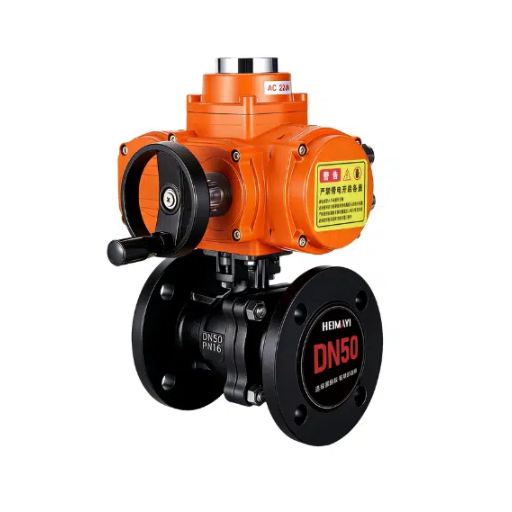
Black Ant manufactures an HVA electric regulating ball valve that uses a “W”-shaped characterised core. It is the same idea under a different letter: a shaped port in a quarter-turn body, cut to deliver an equal-percentage characteristic rather than a quick-opening one. The published range covers DN15 to DN300 at PN16, with 100:1 turndown and a selection of equal-percentage, linear and quick-opening trims.
Black Ant doesn’t publish a separate V-port product, and the W-core is not a V-notch ball in the literal sense; it is the in-house implementation of the same engineering answer.
For a detailed comparison, please see our article on butterfly valve vs gate valve.
Vertex Angle, Flow Characteristic and Cv
Why the Sources Disagree
Ask what characteristic a V-port ball has, and published answers split: some suppliers call the port linear, some describe it as “near-linear”, and Black Ant specifies equal percentage for the main trim on its W-core.
All three can be true, because they describe different vertex angles. The angle is the variable the word “characteristic” hides. Assured Automation, which sells both bodies, credits the globe with “a more linear flow curve”, which implies its V-port is the less linear of the two.
The Angle Decides the Curve
| Vertex angle | Typical characteristic | Control behaviour | Capacity | Typical use |
|---|---|---|---|---|
| 15° | Close to equal percentage | Finest low-flow control, narrowest band | Lowest | Small terminal units, precise low-flow duty |
| 30° | Between equal percentage and linear | Good low-flow control with a usable band | Low to moderate | HVAC coils, general throttling |
| 60° | Near linear | Even response across the stroke | Moderate | Process lines where the load is roughly linear |
| 90° | Near linear, approaching quick opening | Coarser control near closed | Highest of the V range | High-capacity throttling, dirty service |
| Custom or slotted seat | Manufacturer-specific | Varies | Varies | Retrofit and special duties |
Angles are typical values; confirm the curve against the supplier’s Cv table.
What Equal Percentage and Linear Mean Mean in Practice
Equal percentage means each increment of travel produces a constant percentage change in flow, not a constant absolute one. Small increments near closed, large near open. That suits heating and cooling coils, whose output does not scale linearly with flow, and it is why equal-percentage trims dominate HVAC control.
Linear means equal travel produces equal flow change. It suits loops where the measured variable responds proportionally to flow, and it’s easier to tune when authority is stable.
To learn more technical information, please read our article on control valve flow characteristics.
The Capacity and Rangeability Trade
A V-port gives up capacity against a full-port ball, because the notch occupies part of the bore. The narrower the angle, the more you lose. That’s the price of the control band, and it matters when the line was sized close to its limit.
No universal ratio exists; the penalty varies by more than an order of magnitude across the angle range. Read the manufacturer’s Cv at your angle and travel, then compare it with design flow. The Cv guide covers the equation.
Rangeability is the other half: the ratio between the largest and smallest controllable flow. Some suppliers quote more than 200:1 for a V-port trim; Black Ant publishes 100:1 turndown for the HVA regulating ball. Neither number transfers to an unspecified valve.
The flow coefficient comparison makes the trade concrete. Wikipedia’s example puts a 1-inch ball at Cv 80 against Cv 10 for a similarly sized globe, which is why trading some capacity for controllability is often still a net gain.
V-Port Ball Valve vs Globe Valve: Which One Wins the Duty
The Duty Split
| Duty | V-port ball | Globe valve | Verdict |
|---|---|---|---|
| Continuous modulation on a coil or terminal unit | Good, with the right angle | Very good | V-port on size and cost, globe on precision |
| Fine low-flow control | Limited by the smallest angle | Strong | Globe |
| High differential pressure | Actuator torque rises sharply | Handles it with a larger actuator | Globe, unless torque is checked |
| Cavitating or flashing duty | Poor without hardened trim | Better, especially multi-stage | Globe |
| Dirty or slightly abrasive media | Better than a globe, with hardened trim | Trim and seat wear faster | V-port |
| Tight space, tight budget, fast replacement | Small, light, economical | Larger, engineered, longer lead | V-port |
| Isolation with occasional modulation | Strong, tight shutoff in the same body | Not leak-free at shutoff | V-port |
Where the V-Port Wins
A characterised ball is smaller, lighter, and cheaper than a globe of the same line size. It gives tight shutoff in the same body that modulates, which a globe usually does not. Assured Automation’s comparison states plainly that globe valves “do not typically provide a bubble-tight shutoff” and need more force or a larger actuator to seat. A quarter-turn body also has fewer leak paths and needs less torque for the same movement.
The sourcing difference is real too. A globe is an engineered product configured to a data sheet, so lead times reflect that. A characterised ball is closer to a catalogue item with a trim choice, and when a project needs a modulating valve next month, that decides the specification more often than the flow curve does.
Where the Globe Still Wins
Fine control near closed is still the globe’s territory, and so is severe cavitation, where multi-stage trim exists because a single V-notch cannot take the pressure drop without damage. Very high differential pressure and loops whose authority depends on the trim also favour the globe.
Assured Automation notes that globe valves “do not suffer uneven wear in the mid positions”. That is a fair point about a V-notch ball: the V concentrates flow, and where it concentrates it is where it wears. On constant high-cycle modulation at part-open, the globe’s even wear has value.
What Not to Conclude
Don’t read this as an argument for swapping globe valves out to save energy. The arithmetic rarely supports a replacement on its own, as the site’s globe valve vs ball valve comparison works through. Swap the body when the duty has changed, not because a table ranks one body higher.
V-Port Ball Valves in HVAC and Building Services
Where They Fit in a Building
Most of the V-port conversation online is written for process plants. In buildings, the same valve solves a narrower problem: a line needs modulation, and a globe will not fit or will not be affordable in quantity.
Typical positions are fan-coil and air-handling-unit branches, district-heating substations on the secondary side, and terminal units where the actuator must be small and quiet. A fan coil control valve in a characterised-ball body is often the practical answer where a globe would need a bypass and a larger plant room.
Retrofitting an Isolation Line
Many buildings have ball valves on branches that were specified for isolation and are now expected to modulate. Retrofitting is possible, but four things change, and only one is the valve.
The ball and seat change to a characterised trim. The actuator changes from on/off to positioning. The control signal changes to an analogue or bus command. And the Cv assumption changes, because the original line was probably sized on full-port capacity that the new trim cannot deliver.
Check the body first. On three-piece designs, the ball and seat can often be swapped; on many others, the body itself differs, and the honest answer is a new valve.
Actuation the BMS Can Drive
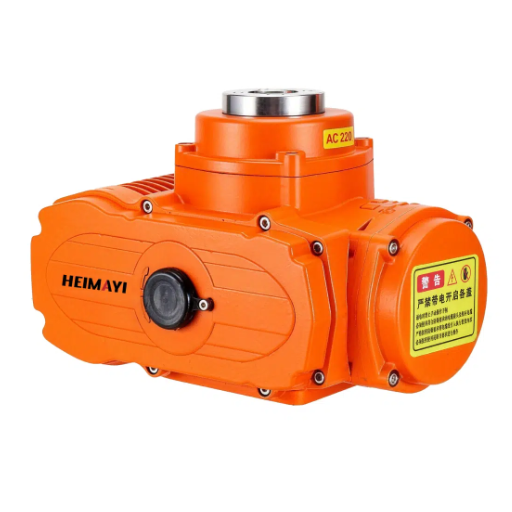
A V-port is bought for modulation, so the actuator has to accept a position command: 4–20 mA, 0–10 V, or a bus signal, with position feedback, a defined fail position, and a stroke time the loop can live with. Black Ant’s HVA publishes 3 to 10 seconds and supports 4–20 mA, RS485, and M-Bus.
Torque, authority, and shutoff class are covered in the site’s electric valve selection guide. The point specific to a characterised ball is that the trim’s flow curve and the actuator’s resolution have to match. A 15° trim with a coarse actuator wastes the angle you paid for.
What Does Not Fit
The published media list for the HVA regulating ball stops at cold water, hot water, up to 50% ethylene glycol, and some refrigerants, between −20°C and 120°C, with an EPDM seal and PN16 body. Chilled water with glycol sits inside that. Steam, aggressive chemicals, and abrasive slurry do not.
Slurry is a genuine V-port application in industry, but it needs hardened trims and a materials selection beyond a standard water valve. Treat it as a separate specification exercise, not a variant of a building-services order.
Specifying a V-Port Ball Valve: Checklist and Failure Modes
The Six-Line Specification
| What to specify | Why it is the line that gets missed |
|---|---|
| Line size and connection | The trim changes the Cv, so the size that worked for isolation may be undersized for modulation |
| Body and trim material against the media | A water-rated body is not automatically a chemical-rated one |
| Vertex angle and required characteristic | The single choice that sets the curve; leaving it blank gets you the supplier’s default angle |
| Cv at the required angle and travel | Catalogue Cv is often quoted at full travel, not at the point the loop actually runs |
| Seat and leakage class | Tight shutoff is a specification, not a promise; state the class you need |
| Actuator type, signal, and fail position | An on/off actuator on a modulating valve is a commissioning failure waiting to happen |
Three Failure Modes
Notch erosion. The V concentrates velocity at small openings, exactly where the valve spends its time. Abrasive media or high velocity wears the notch, and the curve drifts as the geometry changes. Hardened trim buys time, not immunity.
Cavitation at part-open. A valve that is bought to sit at 40% is a valve that spends its life at its highest pressure drop. Check the pressure profile across the valve at the positions the loop uses, not just the shutoff rating on the body.
Solids bridging the V. Fibrous or large particulate media can blind the notch and turn a control valve into a blocked orifice. That is a strainer and selection problem, and the fix belongs upstream.
Manual or Actuated
Manual V-ports exist, usually as a set-and-forget throttling device on a branch that needs a fixed restriction. If the valve has to follow a control signal, the actuator is not an accessory; it is half the specification.
Frequently Asked Questions
Can a ball valve be used for flow control?
A standard ball valve can, badly, because its quick-opening geometry leaves almost no usable control band. A V-port ball valve can do it well, because the notch changes the characteristic into something a controller can work with.
Is a V-port ball valve the same as a segmented ball valve?
No. A V-notch is cut into a spherical ball; a segmented ball is a partial sphere with a shaped edge, usually metal-seated for hotter or dirtier service. They are related answers to the same problem, not the same product.
What angle should I choose: 15°, 30°, 60° or 90°?
Narrower angles give finer low-flow control and a curve closer to equal percentage. Wider angles give more capacity and a curve closer to linear. Confirm the choice against the manufacturer’s Cv table at your design flow.
Do I need a special actuator?
Yes: a positioning actuator with an analogue or bus signal, not an on/off type. The valve’s value is its ability to sit at an intermediate position, and an on/off actuator cannot hold one.
Will a V-port fit my existing ball valve body?
Only if the body was designed for it. The ball and seat are matched parts, and on many designs the body itself differs. Check the model before ordering, or plan for a complete valve.
The Right Body for a Line That Has to Modulate
A V-port ball valve is not a better ball valve. It is a different port, chosen because the line has to sit at part-open and stay there. The vertex angle then sets the curve, the capacity, and the failure mode you will live with.
Confirm the angle against your duty, the Cv at the travel your loop uses, and that the actuator can hold a position. Get those three right and the valve behaves. Get the angle wrong, and you have bought an expensive isolation valve.
Send us the line size, the media, and the duty, and our application engineers will confirm the angle and the Cv for the HVA regulating ball range before you order.
< class="ct-module-title">
Trending now