Globe Valve vs Ball Valve: Which Does Your Line Need?
A globe valve regulates flow continuously by driving a plug toward a seat. A ball valve opens or closes it with a quarter turn of a bored sphere. Most of the globe valve vs ball valve decision follows from that: fit the globe where the line has to modulate, the ball where the job is shutoff or fast isolation, and a characterised ball where you need both.
This covers industrial and building-services valves in water, steam and light process duty, manual or actuated. It doesn’t cover domestic plumbing, laboratory micro-flow, or sanitary designs. Both bodies stop flow. Only one is built to sit at 40% open for years.
Key Takeaways
- A globe valve modulates by design; a standard ball valve modulates by exception. The mechanism, not the price, sets the duty.
- A standard ball has the far lower pressure drop: Wikipedia’s example is Cv 80 for a 1-inch ball against 10 for a globe of the same size, a 64-fold gap at equal flow.
- That gap is a control feature as often as a cost, because a modulating valve needs pressure drop to hold authority over its circuit.
- The V-port or characterised ball, which most comparisons leave out, is usually right when a line needs both tight shutoff and modulation.
- Swapping globe valves for ball valves to save energy rarely repays the work. Swap them when the ball does the duty you actually have.
Globe Valve vs Ball Valve: What Actually Differs
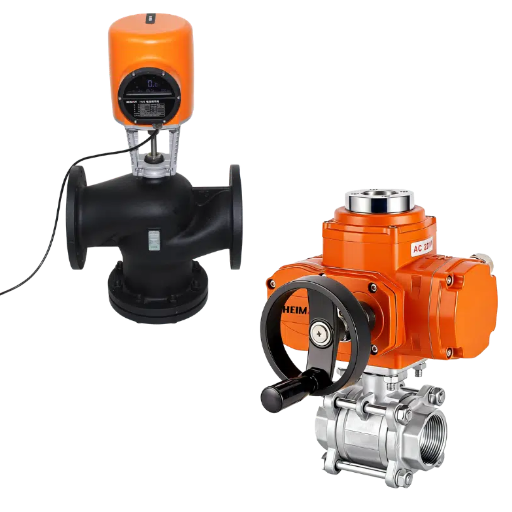
A globe valve is a linear valve. A stem drives a movable plug or disc onto a stationary seat, and the flow turns through the body twice between inlet and outlet. A ball valve is rotary: a bored sphere turns 90 degrees, and once the bore lines up with the pipe, the flow runs straight through.
| Feature | Globe valve | Ball valve |
|---|---|---|
| Motion | Linear, multi-turn | Quarter-turn rotary |
| Flow path | Turns twice through the body | Straight through the bore |
| Throttling | Designed for it | Poor in a standard body |
| Shutoff quality | Good, rarely bubble-tight | Bubble-tight with a soft seat |
| Pressure drop | High, by design | Low when open |
| Actuator torque | High at large DN and high differential | Low, and falls sharply once open |
| Stroke and response | Slow: many turns or a long stroke | Fast: 90 degrees in 5 to 15 seconds actuated |
| Maintenance | Trim renewed in place | Often replaced as a unit |
| Typical failure mode | Seat and plug erosion from wire drawing | Seat damage from throttling or debris |
Industry comparison, no manufacturer-specific figures.
Why the Mechanism Decides the Duty
Every control-valve catalogue is built on the globe body because a linear plug can stop anywhere in its travel and hold that position against pressure. The curve is smooth, the position repeats, and the trim can be shaped to suit the load.
The ball does a different job better. It either lines up with the bore or it doesn’t; the quarter turn is fast, the torque is low, and a soft seat closes bubble tight. That’s why it became the default isolation body, and why it’s a poor substitute when a line has to sit part-open. For the wider selection logic, see our guide to electric valve selection.
The Boundary This Article Sets
A standard ball valve here means a full-port or reduced-port ball with an unshaped port. A V-port or segmented ball is a different component: different characteristics, different torque, usually a different price.
The first half compares the standard bodies. The characterised ball gets its own treatment under matching the valve to the duty, because it’s a third option rather than a variation on the second. Most comparisons blur that line, which removes the body many readers will actually buy.
How Each Valve Controls Flow
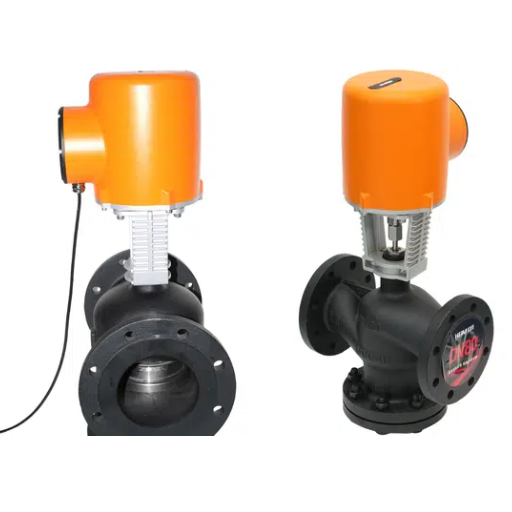
The globe’s stem moves the plug along the seat axis, so travel maps to open area predictably. The ball rotates its port edge across the bore, so the first part of travel changes open area fastest. Actuator matching for both sits in our guide to linear versus rotary electric control valves.
What Happens at Part Open
On a globe, the gap between plug and seat forms an annular orifice, and shaped trim decides how it grows. On a standard ball, the port edge shaves across the bore, giving close to a quick-opening characteristic: most of the flow change happens in a short band of travel and the rest of the stroke does little.
The Characteristic You Actually Get
Globe trim is chosen to match the load. Equal percentage suits most heating and cooling coils, because the coil’s heat-transfer curve compensates for the trim shape and the pair behaves roughly linearly against load. A standard ball has no characteristic to select; a characterised ball approximates one, depending on port geometry. Ball valves are preferred for shutoff, but they lack the fine control of those alternatives in throttling.
A globe valve modulates by design; a standard ball valve modulates by exception. Everything that follows tests that sentence against a duty.
To obtain a detailed comparison, please see our article on throttling valve vs control valve.
Pressure Drop, Cv, and What the Difference Costs
What Cv Means
Cv is the flow in US gallons per minute of 60°F water that passes through a valve at a 1 psi drop. Kvs is the metric equivalent: cubic metres per hour at 1 bar. A higher number means less restriction.
The flow coefficient is the one figure that lets you compare two completely different bodies at the same line size. For the equation and the Kv conversion, see how Cv is calculated.
The Published Comparison
Wikipedia gives a concrete pair: a 1-inch ball valve may have a Cv of 80, while a similarly sized globe valve in the same application may have a Cv of 10. Pressure drop scales with the square of flow divided by Cv, so at equal flow the globe valve pressure drop is 64 times the ball valve pressure drop. Not twice. Sixty-four times.
Worked Example, Illustrative Figures
Scale the same 8 to 1 ratio onto a larger line: 200 gpm of water, a ball with a Cv of 800 and a globe with a Cv of 100.
- Ball: (200 ÷ 800)² = 0.0625 psi
- Globe: (200 ÷ 100)² = 4.0 psi
- Hydraulic power, Q × Δp ÷ 1714: ball 0.01 hp, globe 0.47 hp
The difference is about 0.46 hp, or 0.34 kW. Across 5,000 running hours, that is roughly 1,700 kWh of pump energy a year on this one valve. These are illustrative figures, not a measurement. They assume the pump absorbs the difference, which happens only where surplus head is genuinely being throttled away rather than used elsewhere in the circuit.
Now the honest part. 1,700 kWh is a real number and a small one. Set it against draining the line, cutting out a valve, fitting a replacement, refilling, re-commissioning, and re-balancing, and it rarely repays the work on its own.
If a valve is coming out anyway, take the low-drop body. If it is coming out to save energy, run this arithmetic on your own duty first.
For more information, please read our article on V-port ball valves.
Why High Pressure Drop Is Sometimes the Point
A modulating valve has to own a meaningful share of the pressure in the circuit it controls, or it can’t control that circuit at all. Industry practice puts the target for a control valve’s full-open drop at 3 to 5 psi, because the coil it serves usually drops less than 4 psi and its real value is often unknown at selection. A valve with almost no drop, in a circuit whose other components also have almost none, spends its whole stroke resolving a flow it can’t see, and the loop hunts.
That’s what gets lost when pressure drop is treated as a pure cost. It’s a cost, and it’s also the control authority the valve needs.
To learn more technical information, please read our article on control valve flow characteristics.
Matching the Valve to the Duty
| Duty | Standard globe | Standard ball | V-port or characterised ball | Why |
|---|---|---|---|---|
| Isolation and shutoff | Workable | Best | Good | Tight seat, low cost, quarter turn |
| Continuous modulating | Best | Poor | Good | Needs a shaped characteristic |
| Frequent open-close cycling | Best | Good | Fair | Plug touches its seat only when closed |
| Steam | Best for control | Isolation only, if rated | Rarely specified | Temperature and seat material |
| Dirty or abrasive media | Fair | Good | Fair | Straight bore passes solids |
| High differential pressure | Good with a balanced plug | Good | Good | Torque rises with differential on a globe |
| Tight space or dead-end service | Fair | Best | Best | Compact, no cavity to drain |
| Actuated terminal unit | Good | Poor if modulating | Best | Low torque, fast stroke, tight close-off |
Industry guidance, one line per cell. Read across the row that describes your line, not down a column.
Most specification errors come from reading down a column. The ball wins two rows, holds four, and fails the one that matters most in a building.
Shutoff and Leakage, Qualitatively
Soft-seated balls give the tightest shutoff and are the default isolation choice in building services. Metal-seated designs trade some tightness for temperature and abrasion resistance. Leakage classes are defined in ISO 5208 and EN 12266-1. The point of a class system is that tightness is a specification, not an adjective: a valve is tight to a class, at a test pressure, in a stated direction.
The Third Option: V-Port and Segmented Ball Valves
A characterised port gives a usable control curve inside a quarter-turn body, with tight shutoff and a compact envelope. The V-port ball valve wins on HVAC terminal units and on retrofits where an isolation line now has to modulate. It loses on fine low-flow control, severe cavitating duty, and small sizes where availability is thin.
Two trade-offs matter. A wider V-port can pass more flow than a globe of the same size, so it’s a capacity choice as well as a control choice. And cycling wear runs opposite to intuition: a globe plug touches its seat only when closed, while a ball sits against its seat continuously.
Where a Standard Ball Fails as a Control Valve
Below roughly 20 to 30% travel, the characteristic is too steep to use. The loop overshoots, the actuator strokes constantly, and the seat sees high velocity through a narrow gap. The failure appears slowly and reads as a controls problem rather than a valve problem, which is why it survives so many investigations.
Illustrative scenario, not a customer case. A building replaces failed globe valves on its fan-coil branches with standard ball valves, on the logic that the ball costs less and closes tighter. Commissioning passes at design conditions. Through the shoulder season, the rooms overshoot, because each valve already passes design flow at around 20% travel and the rest of the stroke only hunts. The fix isn’t more controller tuning. It’s a characterised ball, or the globe that was there before.
For a detailed comparison, please see our article on butterfly valve vs gate valve.
Globe Valve vs Ball Valve in HVAC and Building Services
| Location | Usual choice | Why | Watch-out |
|---|---|---|---|
| Plant-room isolation | Ball | Tight shutoff, quarter turn, compact | Large sizes may need a gear operator |
| Riser and branch isolation | Ball | Low cost, positive shutoff | Check access for handle or actuator |
| AHU coil control | Globe or characterised ball | Equal-percentage modulation | Size the Cv to the coil, not the pipe |
| Fan-coil and terminal unit | Characterised ball or small globe | Low torque, tight close-off, compact | A standard ball controls badly here |
| District-heating substation | Globe for control, ball for isolation | High differential and high temperature | Materials and packing rating |
| Steam line | Globe for control, ball for isolation | Throttling without wire drawing | Condensate and water hammer |
Industry practice for building services. Confirm material and pressure class against the line conditions. Large plant isolation is often butterfly, which this article does not compare.
What Changes When an Electric Actuator Is Fitted
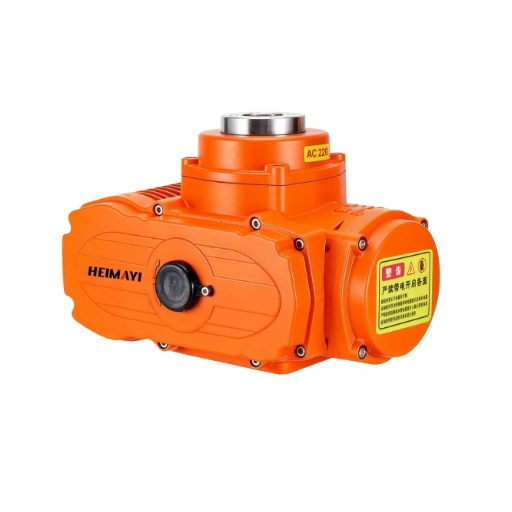
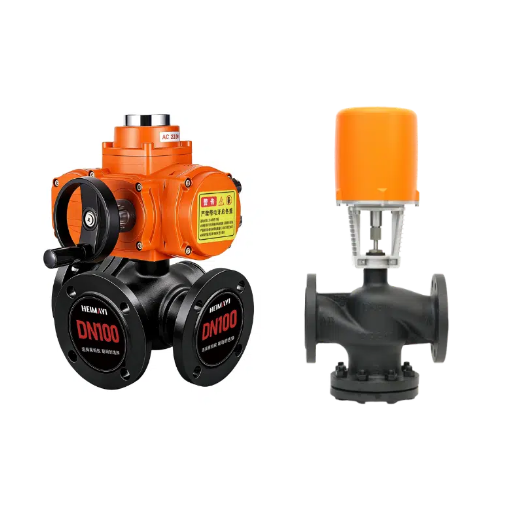
The globe wants more torque per DN at high differential, strokes more slowly, and holds a modulating position steadily. The ball wants very little torque, turns 90 degrees in seconds, shuts off positively, and fails to a defined position with a spring return. You specify the same things for both: control signal, fail position, and whether the actuator must hold against the differential or only against friction.
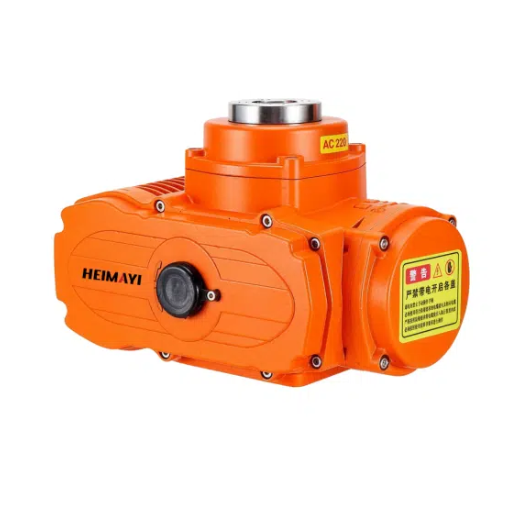
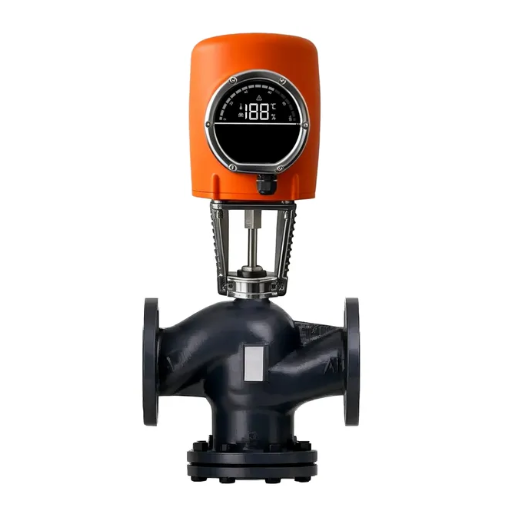
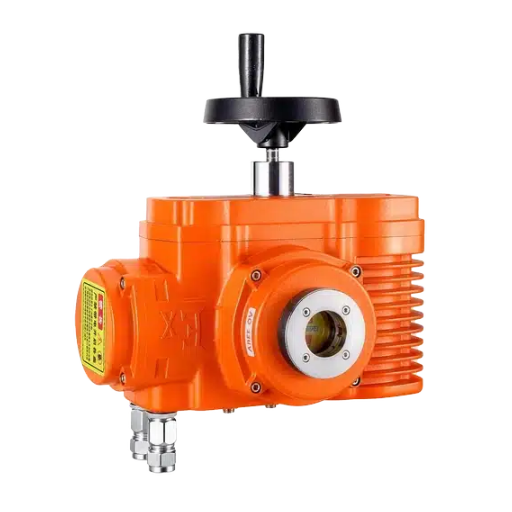
Black Ant makes both bodies in actuated form. The electric globe control valve covers DN15 to DN150 at PN25 and -20°C to 220°C, with leakage down to 0 to 0.01%, and accepts 0 to 10 V, 4 to 20 mA, or 0 to 1,000 Ω control. The electric ball valve covers DN15 to DN300 at PN16, with a maximum shutoff differential of 1,200 kPa, 50 to 5,000 N·m output torque, and a 5 to 15-second full stroke, controlled by 4 to 20 mA, RS485, or M-Bus.
Part-load hours dominate a building’s operating year. Match the valve to how the terminal actually runs.
Cost, Maintenance and Lifecycle
Purchase, installation, maintenance, and energy. Most comparisons stop at the first, and it’s the least reliable, because reducers, adaptors, and extra installation time disappear from a quotation that lists only the valve.
| Cost element | Globe | Ball | What drives it |
|---|---|---|---|
| Purchase | Index 1.3 to 1.6 | Index 1.0 | Trim, materials, whether an actuator is included |
| Installation | Index 1.0 | Index 1.1 to 1.3 where reducers are needed | Face-to-face length, weight, pipe size |
| Maintenance | Index 1.0, trim renewed in place | Index 0.6 to 0.8, often replaced whole | Access, spares, labour rate |
| Energy | Index 1.0 | Index 0.02 to 0.2 of valve losses | Duty cycle, pump efficiency |
Relative indices, illustrative only, standard ball at 1.0 for purchase and globe at 1.0 for energy. No currency on purpose. Assumptions: both bodies correctly sized, soft-seat ball, globe with renewable trim, energy index derived from the Cv ratio above.
A globe usually costs more to buy. A ball usually costs less to maintain, because a unit swap is faster than renewing trim in place. The energy direction is real but small, and it’s the one most often overstated.
Can I Replace a Throttling Globe With a Ball?
Yes, if the duty is really on and off, the circuit is re-balanced afterwards, and actuator torque and fail position have been re-checked against the new body. No, if the valve does continuous modulation, unless the replacement is a characterised ball. Check either way: the Cv against the coil, the shutoff class against the specification, and whether the controller’s output still matches the body it drives.
Oversizing is the most common reason a replacement doesn’t control as well as the valve it replaced.
On isolation duty, buy the ball and spend nothing else. On modulating duty, buy the globe or the characterised ball and size the actuator properly. Paying for modulation on a line nobody adjusts is the most persistent waste in this decision, because it never shows up as a failure.
Frequently Asked Questions
Is a ball valve better than a globe valve?
No, the duty decides. A ball valve is better for shutoff, isolation, and fast operation. A globe valve is better for continuous throttling. A V-port or characterised ball valve covers duties that need both, at a higher price than a standard ball.
Which valve has the least pressure drop?
A standard ball valve, by a wide margin. In Wikipedia’s example, a 1-inch ball has a flow coefficient of 80 against 10 for a globe of the same size. Low drop is not always an advantage, because a control valve needs some drop to control with.
What type of valve is best for steam?
Globe valves for control and throttling, and ball valves for isolation where the seat and packing are rated for the temperature. Specify the pressure and temperature class rather than assuming it, and watch for condensate and water hammer on either body.
Are ball valves the same as isolation valves?
No. Isolation is a duty, not a design. Ball valves are the most common isolation choice in building services, but globe, gate and butterfly valves are also used where the duty or the code requires it.
Does flow direction matter on a globe valve?
Yes. Most globe valves are directional, because the plug is arranged so line pressure either assists or opposes opening depending on the design. Fit them against the arrow on the body, not by convenience on the pipe run.
Can a ball valve be used for throttling?
A standard ball valve throttles poorly because its characteristic is too steep near closed, and its seat erodes while it does. A V-port or segmented ball valve is designed for it and gives a usable curve, tight shutoff, and a compact envelope.
How do the P&ID symbols differ?
A globe valve is drawn as a bow-tie with a circle in the centre. A ball valve is drawn as a bow-tie with a ball-and-bore symbol. Both share the same body outline, so the centre is the part to read.
Conclusion
The globe valve vs ball valve decision comes down to four questions: what the line does, how often it moves, what the media is, and what the actuator has to hold. Answer those in order, and the body type falls out without a pros-and-cons list. The wrong choice is rarely the wrong valve. It’s a globe on a line nobody adjusts, or a standard ball on a line that modulates all day.
If you’re working through the numbers for a specific circuit, our guide on how to size a control valve walks you through the method from Cv to authority. If you’d rather check a selection against a real duty, send us the duty and the differential, and our application engineers will confirm the body, the trim, and the actuator against it.
< class="ct-module-title">
Trending now