Valve Positioner vs Actuator: What Each One Does and When You Need Both
A valve positioner and a valve actuator are not the same device. The actuator supplies the force that moves the valve, while the positioner measures where the valve ended up, compares that with the command signal, and corrects the drive until the two match.
That division of labour is easy to see on a pneumatic valve, where the actuator and the positioner are two separate boxes bolted together. It becomes invisible on an integrated electric actuator, because the positioner function sits inside the housing you already bought. Many comparison pages stop at the muscle and brain analogy. This page explains what each device does, when a pneumatic valve needs a positioner, and how the answer changes when the actuator is electric. From a comprehensive perspective, the electric valve selection guide covers body type, torque, characteristic, and leakage class.
Key Takeaways
- An actuator produces force or torque; a valve positioner closes the position loop and corrects for friction, differential pressure and hysteresis.
- A pneumatic modulating valve usually needs a positioner when packing friction or varying differential pressure would hold the plug off setpoint. An on/off valve usually doesn’t.
- An electric actuator with integrated position feedback already contains the positioner function, so a separate unit is not normally fitted.
- A positioner can’t fix bad sizing, a sticking stem or a wrong fail position. It can only mask them.
- Specify the command signal, the feedback signal, the fail action and the stroke time separately, whichever actuator type you choose.
If you are weighing a pneumatic package against an electric actuator for a building system, send the duty point and signal type to our engineers, and we will confirm which route fits.
The Difference Between an Actuator and a Positioner
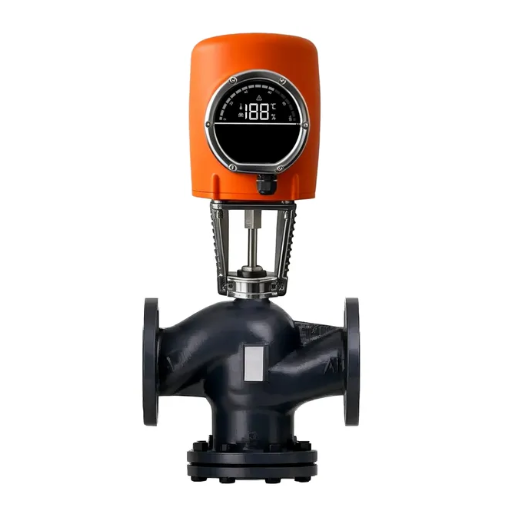
An actuator is an energy converter. A pneumatic diaphragm actuator balances air pressure against a spring, a piston actuator uses air on one or both sides of a piston, and an electric actuator uses a motor and gear train to produce torque or thrust. The output is always mechanical: a stem moves, a shaft turns, a disc or plug changes the open area.
A positioner is a controller mounted between the control system and the actuator. It receives the command signal, measures the valve’s actual position, and adjusts the energy supplied to the actuator until position and command agree. It doesn’t produce the force. It decides how much force the actuator should apply.
| Function | Actuator | Positioner |
|---|---|---|
| Produces torque or thrust | Yes | No |
| Moves the valve stem or shaft | Yes | Commands the actuator |
| Measures actual position | Sometimes, through limit switches | Yes, continuously |
| Corrects for friction and differential pressure | No | Yes |
| Converts a signal, for example 4-20 mA, to air pressure | No | Yes, in an electro-pneumatic unit |
| Can work open loop | Yes | No |
| Sets the fail position | Yes, through the spring or mechanism | No |
The common description calls the actuator the muscle and the positioner the brain. That’s fair for a pneumatic control valve, and Wikipedia’s control valve article uses the same functional split between the valve, the actuator, and the accessory.
The analogy breaks on an electric actuator, where the motor drive and the position sensor share one housing and one controller. Calling that arrangement “an actuator without a positioner” is technically wrong. The function is there; the separate box is not.
One more distinction matters during specification. Direct acting and reverse acting describe the relationship between signal and position. A positioner can invert that relationship electronically or pneumatically, which helps when a valve body and an actuator are matched in the opposite sense.
It can’t invert the spring. Fail action remains an actuator property, and the fail-safe control valve guide covers how springs and stored energy set it.
What a Valve Positioner Does
A valve positioner receives the command signal, compares it with the valve’s actual stem or shaft position, and adjusts the pressure or drive until the difference is zero. The comparison is continuous, and the correction happens many times during a stroke.
The sequence has three steps:
- Receive the signal. A pneumatic valve positioner takes a 3-15 psig signal. An electro-pneumatic positioner takes 4-20 mA and converts it to a pneumatic pressure internally.
- Compare with actual position. A linkage, cam, or internal sensor reports where the stem or shaft really is.
- Adjust the drive. The positioner supplies or exhausts air, or commands the motor, until the valve reaches the requested position.
Spirax Sarco’s actuator and positioner tutorial describes the core relationship plainly: “A valve positioner relates the input signal and the valve position, and will provide any output pressure to the actuator to satisfy this relationship.” It also explains the amplifier role. When a positioner is fitted to an air-to-open arrangement, the spring range can be increased to raise closing force. A 0.6 bar signal may then need about 1.5 bar at the diaphragm, and the positioner supplies that higher pressure from its own air supply.
Two limits follow from the physics. First, a positioner is a proportional device, so it has an offset in the same way a proportional controller does. Spirax puts the proportional band of a typical positioner at 3-6%.
Second, the positioner can only work within the available supply pressure. It can’t make a spring stronger than the one installed. It can’t make an undersized actuator close against a differential it was never sized for.
Three Types of Positioner
| Type | Signal | Needs electrical supply | Suits |
|---|---|---|---|
| Pneumatic | 3-15 psig | No | Hazardous areas, simple loops |
| Electro-pneumatic | 4-20 mA, converted by an I/P | Yes | BMS or DCS driving a pneumatic valve |
| Digital or smart | 4-20 mA or digital | Yes | Diagnostics, auto-calibration, split ranging |
A digital or smart valve positioner uses a microprocessor, auto-calibration, and position diagnostics. Instrumentation Tools describes the diagnostic value well: total stem travel can be logged like an odometer, and a valve signature can expose excessive packing friction, trim interference, and plug or seat problems. That signature reports a mechanical fault. It doesn’t remove one.
Why Pneumatic Actuators Need One
Air is compressible. A pneumatic actuator is therefore a spring balanced against a pressure, not a rigid positioning device. Packing friction that changes as the gland ages, unbalanced plug forces from differential pressure, diaphragm hysteresis, spring tolerance, and a varying differential all push the plug away from the commanded position.
A positioner measures the result and corrects it. That is why Spirax lists six conditions where a positioner should be considered: accurate positioning, faster response, higher closing pressure, unacceptable hysteresis from packing friction, a non-linear actuator that needs linearising, and varying differential pressure that would move the plug.
The sixth condition is the one building engineers underestimate. A valve can hold position perfectly at commissioning and drift once the system differential rises at part load.
Illustrative example, not a customer case study. Names are placeholders. Marta, a building-services engineer at a 180-room hotel, spent a January chasing a hot-water valve that hunted between 40% and 60% opening. The positioner was replaced in February and the hunting stopped. It returned by November. The real fault was a worn stem packing and a partly seized gland. The new positioner had been correcting a mechanical problem until it ran out of authority.
When a Pneumatic Valve Positioner Is Optional
Not every pneumatic valve needs a positioner, and adding one has a cost. Spirax frames the decision as something to consider rather than a fixed rule, which is the right level of certainty.
A positioner is usually unnecessary in four cases:
- On/off duty. The actuator only has to reach an end stop. A positioner adds cost, air consumption, and a device that can fail.
- Modulating duty with low friction and stable differential. If the spring range matches the signal range and the packing is in good condition, the 3-15 psig signal alone may hold position well enough.
- Small, short-stroke valves with light packing load. The friction and unbalanced forces are small, so the positioner corrects very little.
- Applications where the accuracy gained is worth less than the hardware and maintenance cost.
The honest counterpoint is that many “no positioner” installations work until something changes. Packing ages, differential rises, or a pump is rescheduled. The loop then starts to hunt, and the first diagnosis is often “the positioner is bad” when there is no positioner at all.
This is also the point where the technology choice matters. A plant with no compressed air, or a building that wants to remove instrument-air maintenance, may solve the control problem by moving to an electric actuator rather than adding a pneumatic accessory. The electric vs pneumatic valve comparison covers that decision in full. This page stays on the control function.
To learn more information, please read our article on normally open vs normally closed valves.
What Changes When the Actuator Is Electric
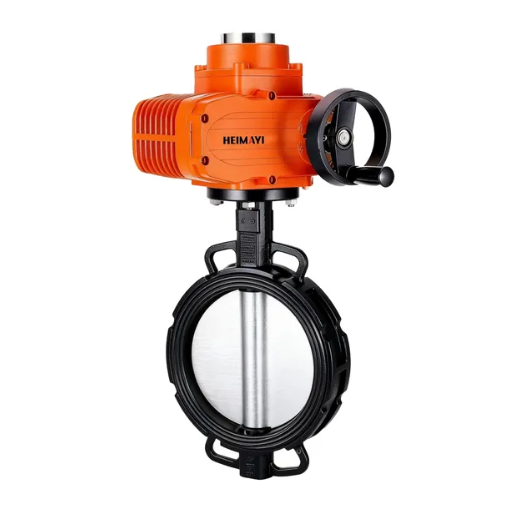
An electric actuator contains a motor, a gear train, and a position sensor. Its controller compares the commanded position with the measured position. It drives the motor until the two match. That’s a position loop, and the valve positioner function is present inside the actuator even though there is no separate unit on the outside.
The practical consequences are significant: no instrument air supply, no filter regulator, no I/P converter, no mechanical feedback linkage to wear, and no pneumatic relay to clog with moisture or oil. Position feedback reaches the BMS as a signal, not just as a mechanical indication.
What doesn’t change is the specification work: command signal, feedback signal, fail action, and stroke time still have to be chosen. Integration removes components, not decisions.
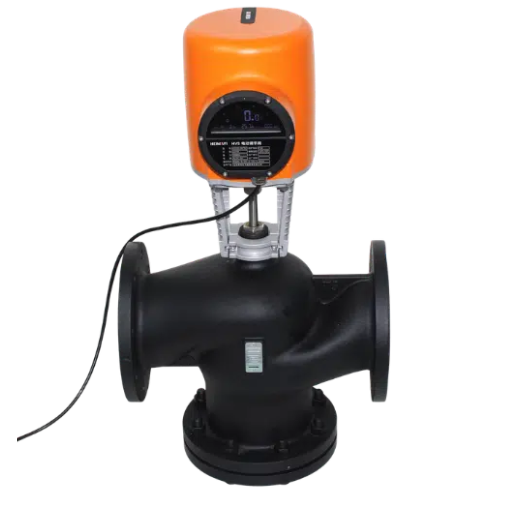
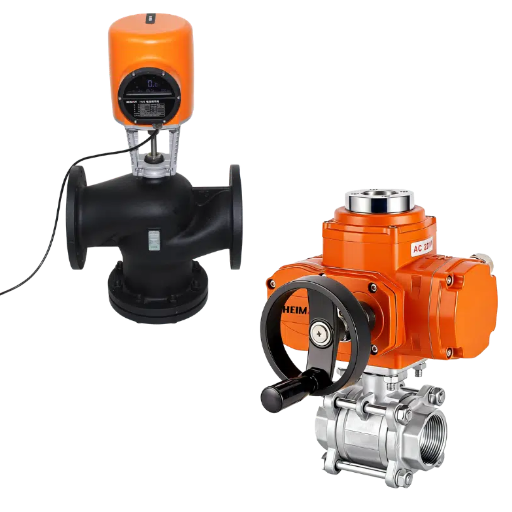
Black Ant’s electric control globe valve page lists “valve position feedback, LED status display, and seamless integration with building automation systems” among its actuator functions. The published control data includes:
- Control signals: DC 0-10V, 4-20mA or 0-1000Ω
- Communication: 4-20mA, RS485 or M-Bus
- Stroke: 20 mm on DN15-DN50, 40 mm on DN65-DN150
- Nominal pressure: PN25
- Media temperature: -20°C to 220°C
- Leakage: 0-0.01%
- Flow characteristic: linear or equal percentage
- Position accuracy: not published
The missing accuracy figure matters. The page provides position feedback, but it doesn’t publish an accuracy figure, so none should be assumed.
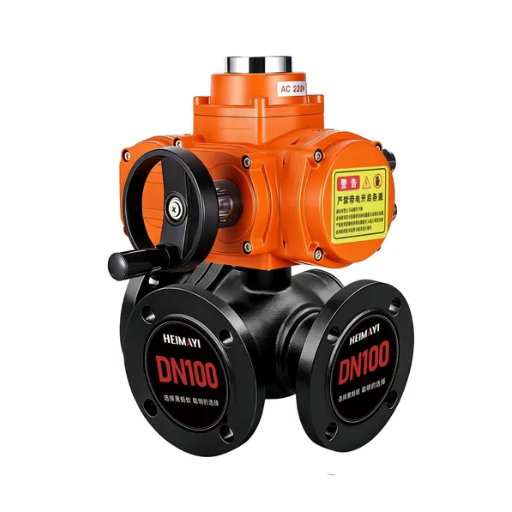
The HVA electric regulating ball valve page goes further. It lists 4-20mA signal output and RS485/M-Bus communication, Modbus and HART, ±1% positioning accuracy, or ±0.5% on the high-precision control type, output torque from 50 N·m to 5,000 N·m, and a 3-10 second response time.
That page does not publish an IP rating, and it lists no 0-10V option; the three-way variant is the one that adds 0-10V input, IP65 to IP68 protection, and a 5-15 second full stroke. Those figures belong to the model named. They are not a general claim about every electric valve.
There is an exception worth stating. Very large, high-thrust, hazardous-area or legacy electric actuators may still use a separate valve positioner or servo controller. The integrated arrangement is the norm for the building-services actuators described here, not a universal law.
For a deep understanding, please read our article on valve torque and actuator sizing.
Positioner, Position Transmitter and Limit Switch
These three devices are often confused because an electric actuator may provide all three functions in one package. They remain separate specifications.
| Device | Job | Signal | Controls position? |
|---|---|---|---|
| Positioner | Compares command with actual position and corrects the drive | Receives command, outputs drive | Yes |
| Position transmitter | Reports actual position to a controller or BMS | 4-20 mA, 0-10 V, or resistance | No |
| Limit switch | Signals that a set point has been reached | Discrete contact | No |
A valve can have a positioner without a transmitter, a transmitter without a positioner, or an electric actuator with both functions built in. The question to ask is not “which device is fitted” but “which functions does the BMS need.”
Illustrative example, not a customer case study. Names are placeholders. Priya managed a 12-AHU retrofit in a 1990s office block. The existing pneumatic actuators each had an I/P converter and a positioner. The replacement electric actuators took a 0-10 V command and returned a 0-10 V position signal. The air line, the I/P and the linkage disappeared from the maintenance scope. The motor, gearbox and sensor appeared. The fail position was still set by the actuator, not by the BMS.
Matching the Control Loop to the Duty
The duty decides whether a separate valve positioner earns its place. Modulating duty with friction or varying differential needs closed-loop correction. On/off duty rarely does. If the actuator already closes the position loop, a separate unit is redundant.
| Actuator type | Duty | Positioner needed? | What to specify | Watch for |
|---|---|---|---|---|
| Pneumatic diaphragm, spring return | On/off | No | Spring range, air supply, seat load | Low signal cannot seat the valve |
| Pneumatic diaphragm | Modulating, low differential | Optional | Signal range, spring range, hysteresis | Packing friction as the gland ages |
| Pneumatic diaphragm or piston | Modulating, high differential or high friction | Yes | Positioner type, supply pressure, proportional band | An undersized actuator masked by the positioner |
| Pneumatic piston | Modulating | Usually yes | Positioner and high-flow air set | Air consumption and exhaust noise |
| Electric, integrated | On/off or modulating | Integrated, no separate unit | Command signal, feedback signal, fail action, stroke time | Assuming every model includes feedback |
| Electric, separate controller or legacy | Modulating | Depends on the actuator | Interface signal, feedback, fail action | Two position loops fighting each other |
The table is a starting point, not a substitute for sizing. A positioner can’t enlarge an actuator. If the actuator can’t close against the differential with the available spring and supply pressure, the answer is a larger actuator, a higher spring range, or a different valve. It isn’t a smarter accessory.
Illustrative example, not a customer case study. Names are placeholders. Kenji commissioned a district-heating substation with two parallel DN100 control valves on one controller. Before split ranging, both valves moved together and the first 20% of load was coarse. The positioners were set so the first valve took 4-12 mA and the second took 12-20 mA. Control at low load improved without changing a valve body. The positioner was doing signal arithmetic, not just position correction.
If you are specifying a valve and are unsure whether the electric route covers the duty, send the size, differential, signal, and fail action to our engineers for a check.
Specifying a Valve Positioner: Five Mistakes That Cost Money
1. Fitting a positioner to fix a sizing or friction problem. A manufacturer states the limit plainly: “A positioner cannot compensate for an undersized actuator or inadequate instrument air supply.” Adding one hides the symptom until the correction range runs out; then the valve fails when the margin is needed.
2. Ignoring air quality. Moisture and oil clog I/P converters and relays, and the positioner gets blamed for a supply problem. A filter regulator is part of the installation, not an optional extra.
3. Treating fail action as a positioner setting. A spring-return actuator fails in the direction its spring drives it. A positioner can invert the command signal, not the spring. Fail-open or fail-closed belongs in the actuator specification, not the accessory schedule.
4. Specifying the command signal but not the feedback signal. A BMS that commands a valve but can’t read its position has no proof of stroke. Position feedback is a separate requirement from the control signal.
5. Commissioning by default. Bench set, zero, span, and deadband have to be set for the installed spring range and stroke. Auto-calibration finds the ends of travel. It doesn’t choose the fail direction or confirm the spring range. The procedure for a digital unit is in the smart valve calibration guide.
A useful test before ordering: write down the command signal, the feedback signal, the fail position, and the required stroke time on one line. If any of the four is blank, the specification is not finished.
Where Black Ant Fits in This Decision
Black Ant manufactures electric control valves and electric actuators. Its globe valve range provides valve position feedback, LED status indication, 0-10V, 4-20mA, or 0-1000Ω control, and RS485 or M-Bus communication. The HVA regulating ball valve adds Modbus and HART, with control accuracy of ±1%, or ±0.5% on the high-precision control type. Black Ant does not make standalone pneumatic positioners.
That boundary is deliberate. If a plant is pneumatic and the actuator is sound, the right purchase is a positioner from a pneumatic specialist. If the plant is electric, or is being converted to electric, the positioning function is already part of the actuator, and the specification work moves to the signal, feedback, and fail action.
For actuator selection itself, the electric valve actuator guide covers types, torque, and duty. For the terminology around motorised units, the motorized valve actuator page explains where the names overlap.
For a product example with integrated feedback, see the electric control globe valve range.
FAQ
Are a positioner and an actuator the same thing?
No. The actuator produces the force that moves the valve. The valve positioner measures the result and corrects the drive until the valve reaches the commanded position. On a pneumatic valve, they are separate devices. On an integrated electric actuator, they share a housing.
Do all control valves have positioners?
No. On/off valves usually don’t need one. Modulating pneumatic valves often do, especially where packing friction or differential pressure would move the plug off setpoint. Electric actuators with integrated feedback contain the function without a separate positioner.
Does an electric actuator need a positioner?
Not normally, if it has integrated position feedback and a closed position loop. Large, legacy, or hazardous-duty electric actuators may still use a separate controller. Check the actuator datasheet rather than assuming either way.
Can a positioner fix a sticking valve or a badly sized valve?
No. It can compensate for friction until it runs out of correction range, which delays the fault rather than fixing it. A sticking stem needs mechanical attention. A badly sized valve needs a different valve or actuator.
Does a positioner determine the fail position?
No. Fail action comes from the actuator spring or mechanism. A positioner can invert the command signal, but it can’t change which way the spring drives the valve when air or power is lost.
Conclusion
The actuator supplies force, and the valve positioner supplies feedback and correction. On a pneumatic valve, those are two devices, and a positioner earns its place when friction, differential pressure, or hysteresis would otherwise move the plug off setpoint. On an integrated electric actuator, the positioner function is inside the housing, so the question changes from “which accessory” to “which signals and fail action.”
Three checks settle most projects. Does the valve modulate? Do load and friction move the plug? Does the actuator already close the loop?
If the third answer is yes, a separate positioner is redundant. If the second is yes and the third is no, a positioner is doing real work.
If you are choosing an electric actuator for a building system, send the valve size, duty, command signal, and fail action to our team. We will confirm the actuator and feedback arrangement against the duty, and tell you when a separate pneumatic valve positioner is the better answer.
< class="ct-module-title">
Trending now