Cage Guided Control Valves: Trim, Capacity and Cavitation Resistance
A cage-guided control valve guides the plug inside a perforated cylinder. The number, size, and shape of the openings in that cylinder set the valve’s capacity, its flow characteristic, and how it behaves under pressure drop, noise, and cavitation. The body and the actuator are the fixed parts. The cage is the part you choose.
Two valves can leave the same factory with the same DN, the same stroke, and the same actuator and still pass very different flows. Same casting, different trim. That difference is a specification, not a tuning problem.
This guide covers how the cage sets Cv and characteristic, why a balanced plug changes the actuator, and where multi-stage cages help. From a comprehensive perspective, the electric valve selection guide covers body type, torque, characteristic, and leakage class.
Checking a selection now? Send the duty and the datasheet to our application engineers, and we will work through the trim with you.
Key Takeaways
- A cage is the configuration part of the valve. Change it and Cv, characteristic and pressure-drop behaviour change while the body, stroke and actuator stay.
- Capacity is port area, not body size. Reduced trim is a cage change, so one body and actuator can cover several duties.
- Balanced plugs cancel most of the pressure force, so a smaller actuator can do the work. The balancing seal is a wear part.
- Multi-hole cages spread the jet; multi-stage cages split the drop. Neither fixes flashing, and both cost capacity.
- Leakage class follows construction. Class IV is the metal-seated norm, and Class VI normally needs a soft seat.
What a Cage-Guided Control Valve Does
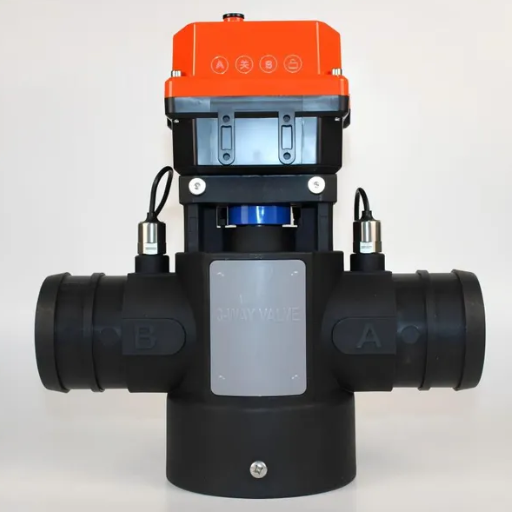
A cage-guided control valve, sometimes written as cage guided control valve in catalogues and also called a sleeve valve, holds the plug inside a cylindrical cage. The cage sits between the body and seat ring, surrounds the plug for its full travel, and takes the pressure drop across its ports rather than across the seat.
The cage does three jobs, and they are separate design decisions:
- Guide. The plug is supported along the cage bore instead of at a single top guide. Side loads are carried by the cage wall, which is why cage trim stays stable at high drop and in large sizes.
- Characterise. The window shape defines the flow path, and the flow path defines the characteristic. Valmet states it plainly: “The window shape defines the flow path through the valve and the flow characteristic of the valve.” (Valmet, control valve sizing coefficients, p.31)
- Condition. Hole count, size, and arrangement divide the jet, set local velocity, and decide where pressure is recovered. Low-noise and anti-cavitation trims start here.
Catalogue pages usually list the advantages without separating these jobs, which is why one list sells both a general-service valve and a severe-service one. The single-seat, double-seat, and cage-guided comparison is in the three globe valve designs compared and is not repeated here.
How a Cage-Guided Control Valve Sets Capacity: Cv, Kvs and Reduced Trim
Cv is the number of US gallons per minute of water at 60°F that pass through a fully open valve at a drop of 1 psi. Kv is the same idea in metric units, and Kvs is the Kv at full travel.
In a cage-guided control valve, capacity is port area. Stroke is fixed by the actuator, bore by the line size, and the only thing that changes flow at full open is how much area the cage presents. That is why one body is sold with several Cv values.
The characteristic is a separate choice made by the same part. A linear cage passes flow roughly in proportion to stroke. A cage cut for an equal-percentage characteristic passes a fixed percentage of the current flow for each increment of stroke, which compensates for a circuit where the valve’s share of the drop falls as flow rises.
CIRCOR’s D-Series offers full trim and reduced trim at 80%, 60%, and 40% of full Cv. Hammel Dahl states the consequence exactly: “Cv reductions are achieved by reducing the area of the cage openings, not by changing its diameter or valve travel, thus eliminating the need for changing actuators.” (Hammel Dahl V510/520 bulletin)
| Trim | What changes | Typical use | Actuator |
|---|---|---|---|
| Full | Full port area | Duty close to the body’s maximum Cv | Unchanged |
| 80% reduced | Fewer or smaller ports | Mild oversizing | Unchanged |
| 60% reduced | Fewer or smaller ports | Valve that runs below 20% of stroke | Unchanged |
| 40% reduced | Fewer or smaller ports | Small minimum flow in a line sized for the pipe | Unchanged |
Percentages are CIRCOR D-Series figures. Other manufacturers publish their own ratios; the principle is the same.
An oversized valve can therefore be brought back into a controllable stroke band without touching the body, the actuator or the piping, and a plant can standardise on one body with reduced cages as spares.
An illustrative scenario, not a measured case. A chilled-water valve is selected on the body’s maximum Cv because that is the number in the line-size column. Most of the year the load is 20% of design, so the plug works between 10% and 18% of stroke. It is stable only because the positioner is slow; tuned properly, it hunts. A 60% reduced cage moves the same duty to 35% to 60% of stroke. The capacity was never the body’s. It was the cage’s.
One caution: a reduced cage lowers maximum Cv but does not create rangeability. KOSO quotes 50:1 to 20:1 for its 501G range, and Neway quotes 50:1, both trim figures, and neither tells you what Cv the loop needs. Cv at maximum, normal, and minimum flow decides the trim; our control valve sizing guide walks through that arithmetic.
Balanced Plugs: How a Cage Guided Control Valve Saves Actuator Force
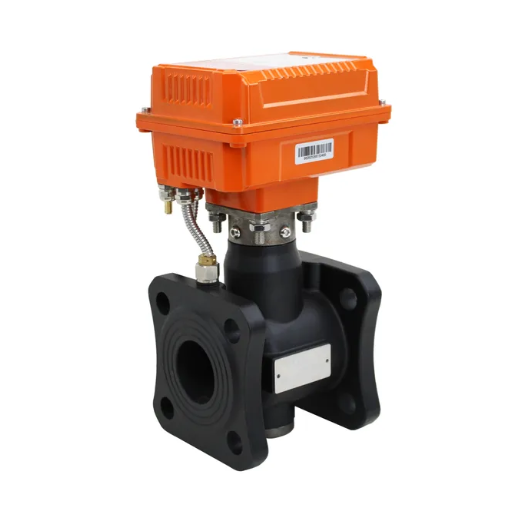
In an unbalanced plug, line pressure acts on the full plug area. The actuator must overcome that force plus friction plus seat load, and the force rises with differential pressure and seat diameter.
A balanced plug turns that into a small number. Balancing holes connect the upstream face to the space above the plug, so pressure acts on both ends, and the net stem force largely cancels. The holes sit on the top of the plug. CIRCOR’s wording is the clearest in the literature: “Balanced Plug design allows line pressure under the plug to build up above the plug, effectively cancelling out any unbalanced stem force due to pressure.”
The same brochure notes that balanced plugs allow small, light, cost-effective actuators. (CIRCOR D-Series technical brochure)
| Unbalanced plug | Balanced plug | |
|---|---|---|
| Stem force | Rises with ΔP and seat area | Largely cancelled by pressure on both faces |
| Actuator | Larger and heavier | Smaller for the same duty |
| Extra parts | None | Balancing seal or piston ring |
| Maintenance | Seat and guide wear | Seal wear adds an inspection item |
What you gain is a smaller actuator, less thrust, finer positioning at small openings, and less tendency to hunt. What you pay is the balancing seal, which wears, is limited by temperature and cleanliness, and adds a second leak path.
An illustrative scenario, not a measured case. A balanced trim starts to feel weak after four or five years. The positioner is retuned, then replaced, and the valve is still slow. The balancing seal has worn, so the plug is no longer balanced, and the actuator is fighting a force the trim was designed to cancel. The fault was a wear part.
Multi-Hole and Multi-Stage Cages: Pressure Drop in Steps
A single-stage cage guided control valve takes the whole drop across one set of openings. The jet leaving the window reaches its highest velocity there, local pressure at the vena contracta reaches its lowest, and that is where cavitation starts and noise is generated.
Multi-hole cages replace one large window with many small holes. The jet is divided, the wetted perimeter rises, and radial forces partly cancel. CIRCOR notes that opposed holes increase the valve’s cavitation index (Kc) and direct impinging flow toward the cage centre. Damage and noise fall at a given drop, but the drop is still taken in one stage.
Multi-stage cages take the drop in two or more steps, so the pressure inside any one stage stays above vapour pressure for a larger overall drop. CIRCOR’s Les-Cav is offered in single or dual stages. Hammel Dahl’s Q-Cage Level 2 adds a second active stage through a plug skirt and claims up to another 10 dBA over the single-stage cage. For the noise trim, CIRCOR states that Les-Sonic can reduce fluid-generated noise by up to 15 to 20 dBA.
Two coefficients tell you what the cage is doing. FL is the pressure recovery factor: the higher the FL, the less pressure the trim recovers downstream of the vena contracta, and the more drop it survives before cavitation. That is why anti-cavitation trims publish higher values.
CIRCOR gives FL 0.8, Kc 0.65, and xT 0.7 for standard D-Series trim, and FL 0.9 and Kc 0.79 for Les-Cav, which publishes no xT. xT is the pressure-drop ratio factor used in compressible-flow sizing, and Les-Sonic publishes xT 0.65. Both coefficients are defined in IEC 60534-1 and used in ISA 75.01 sizing.
Staging stops helping in five places:
- Flashing. If downstream pressure stays below vapour pressure, the vapour never collapses.
- No inlet margin. If inlet pressure is already near vapour pressure, no stage can recover margin that is not there.
- Dirty service. The smallest passages plug first.
- Capacity. A restrictive cage passes less at full open, so the body may need to be a size larger.
- Complexity. More stages mean more part numbers and longer lead times.
The physics, including sigma, Kc, and the damage mechanisms, is in our guide to control valve cavitation. The mitigation programme is in multi-stage trim solutions for electric globe valves.
Leakage Class: What a Cage-Guided Control Valve Cannot Fix
ANSI/FCI 70-2 sets the shutoff classes. Class IV is the common default for metal-seated control valves, Class V is tighter metal seating, and Class VI is the tightest, which in practice means a soft seat.
Published examples follow one pattern. Hammel Dahl’s V510/520 is quoted Class II through V. KOSO’s 501G is Class IV or V with metal seating and Class VI with a soft seat.
Neway’s CSC is Class IV, V, or VI, with Class VI requiring a soft seat. Metal seat, Class IV or V; soft seat, Class VI.
In a balanced valve, the balancing seal often sets the class at temperature. Hammel Dahl’s pairings:
- PTFE piston seal with a metal-seated cage: Class IV below 204°C
- carbon-graphite seal: Class II from 204 to 537°C
- metal piston ring: Class III from 204 to 426°C
Class V needs a spring-loaded PTFE cup seal.
There are three leakage paths, not one: plug to seat, cage to seat-ring joint, and the balancing seal. A perfect plug does not fix a damaged joint, and a cage valve is a control valve, not an isolator, unless Class VI soft seat is quoted and tested as such.
For a detailed comparison, please see our article on globe valve vs ball valve. To learn more information, please read our article on control valve leakage classes.
Where Cage-Guided Trim Wins, Where It Loses, and How to Specify It
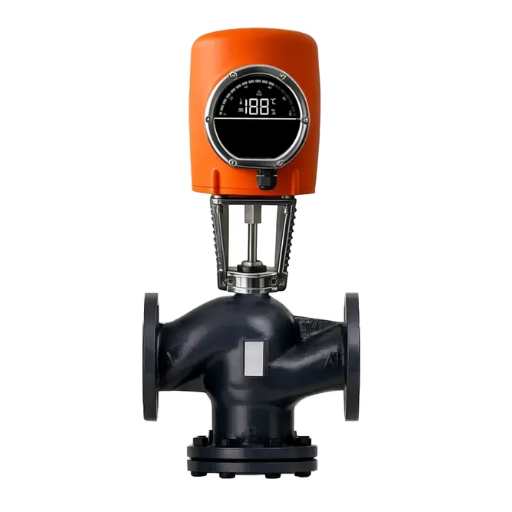
Where Cage Trim Wins
A cage-guided control valve is at its best where the duty is hard and the valve is large. High pressure drop and high pressure class suit it, because the cage carries the guiding load. Big line sizes suit it, because a top-guided plug would need a heavier stem.
Noise and cavitation duties suit it when the cage architecture matches the mechanism. Duties that may change suit it too, because the trim can be swapped without changing the body.
Where It Loses
It loses in dirt and in small sizes. Abrasive fluids erode windows and plug holes. Very small valves are simpler as a top-guided single seat.
Viscous fluids gain nothing from narrow passages. Tight shutoff and budget duties are better served elsewhere.
How to Specify and Maintain the Trim
A datasheet needs nine things:
- Cv at maximum, normal, and minimum flow
- the flow characteristic
- p1, p2 and ΔP
- fluid, temperature, and solids content
- shutoff class and seat type
- noise limit in dBA
- cavitation margin or Kc
- actuator thrust at maximum ΔP
- the spare trim policy
Record the valve size, trim part number, Cv, characteristic, cage type and seal material. Replace cage and seat ring as a set; never fit a cage from another size, and check the balancing seal at every inspection, because a worn seal changes actuator behaviour before it changes flow.
| Symptom | Likely cause | What to check |
|---|---|---|
| Loop hunts after a trim replacement | Characteristic or Cv changed | Trim part number, characteristic, and Cv against the original datasheet |
| Actuator stalls or moves slowly | Lost balance or seal friction | Balancing seal condition, stem force at maximum ΔP |
| Capacity too high at full open | Full trim when reduced was ordered | Cage part number and port area |
| Capacity too low at full open | Plugged or eroded ports | Cage cleanliness and port condition |
| Noise or erosion at the cage | Drop too high for the trim fitted | FL and xT of the installed trim, staging, downstream pressure |
An illustrative scenario, not a measured case. A cage is replaced during an outage. Same size, same Cv on the work order, but stores picked a linear cage for a loop commissioned with equal percentage. At high load, the loop looks fine. At low load, it oscillates, and a retune hides the symptom at the top end. The correct cage, not a new controller, is the fix.
Cage trim is a severe-service specification, not the default for building services. Black Ant’s electric globe control valves are published for DN15 to DN150, PN25, -20 to 220°C, leakage of 0 to 0.01%, and linear or equal-percentage characteristics for HVAC water and steam duty. That is a different specification, and we do not present it as the same product.
Frequently Asked Questions
What is the working principle of a cage-guided control valve?
The plug slides inside a perforated cage. Flow passes through the cage openings; the plug position decides how much area is open, and the drop is taken across the ports rather than the seat.
Cage-guided or single-seat: which should I choose?
Cage-guided for high drop, large sizes, noise or cavitation duty, and quick trim changes. Single-seat where the duty is moderate, the valve is small, or tight shutoff dominates.
Can I change the Cv by changing only the cage?
Yes, within a trim series. The body, stroke, and actuator usually stay, which is the point of reduced trim. Check the seat ring and seal, because they are matched to the trim.
Does a multi-stage cage stop cavitation?
It raises the drop a valve can take before cavitation starts, provided there is inlet margin. It does not stop flashing, and it cannot help when inlet pressure is already at vapour pressure.
Is a cage valve the same thing?
In industrial use, yes. Cage valve, cage trim valve, cage type control valve, and cage guided globe valve all describe the same construction. The phrase is also used for heart valves and automotive parts, which is why search results for it are mixed.
Conclusion
Size a cage-guided control valve on the cage’s Cv, not on the body’s maximum. Match the characteristic to the load the loop actually sees. And choose the cage architecture for the pressure drop and the fluid, not for the brochure photograph.
Get those three right and the body, the actuator and the piping usually stay put for the life of the plant.
If the duty sits close to a boundary, or a replacement cage has changed how the valve behaves, send us the datasheet and the operating conditions. Our application engineers will check the trim against the duty and tell you what the next cage should be.
< class="ct-module-title">
Trending now