

Multi Jet Water Meter: Working Principle and AMR Retrofit
Most residential water meters in the world are mechanical. Most of those are multi jet water meters. And most of them are still read by hand.
That’s not a metering problem. It’s a data problem, and it has a cheaper fix than replacement.
This guide covers the meter itself and the decision that follows from it. How the jet arrangement works and why it beats a single jet. What R160 actually means and why the biggest number on the datasheet is often the wrong one.
It also covers where the technology stops being competitive, and the upgrade path most utilities overlook: reading the meters already in the ground instead of buying new ones.
What Is a Multi Jet Water Meter?
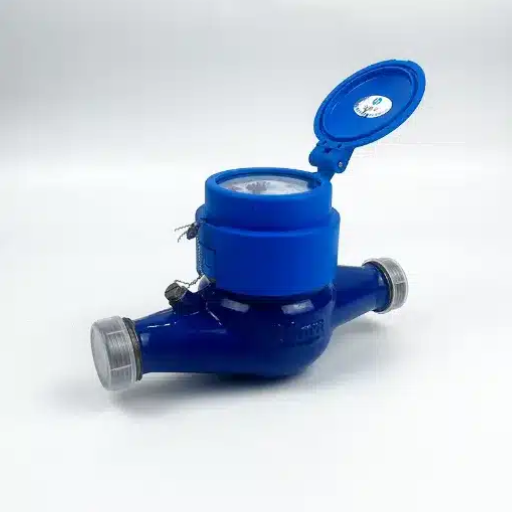
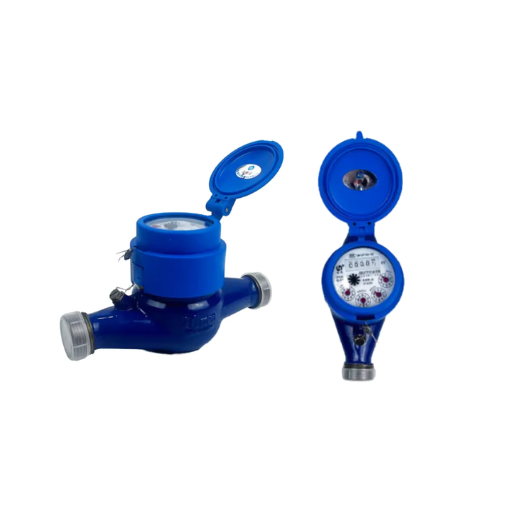
A multi jet water meter, often written multijet water meter, is a velocity-type mechanical meter that divides incoming flow into several tangential jets striking a rotating impeller around its circumference. Impeller speed is proportional to flow rate, and rotation passes through a gear train or magnetic coupling to a register that totalises volume. It is the most widely deployed meter type for residential and light commercial cold-water billing.
Four things describe the category at a glance:
| Parameter | Typical value |
|---|---|
| Sizes | DN15 to DN50 (up to DN150 in specialised designs) |
| Accuracy | Class 2, R80 to R160 |
| Pressure rating | PN16 standard, PN25 available |
| Temperature class | T30 (cold), T50, T70/T90 for hot water |
It dominates for a reason. Per litre of accuracy, nothing else is as cheap to buy, as tolerant of moderately dirty water, or as easy to repair. Above DN50 that equation reverses, and turbine, electromagnetic, or ultrasonic meters take over.
Within the wider set of types of water meters, the multi jet is the residential workhorse. It is not the most accurate mechanical design at very low flow; that honour belongs to the positive displacement meter, which counts fixed chamber volumes rather than inferring velocity.
How Does a Multi Jet Water Meter Work?
The multi jet water meter working principle is simple to state and worth understanding properly, because every accuracy claim and every failure mode follows from it.
- Water enters through a strainer that removes grit before it reaches the measuring chamber.
- It passes into a distributor ring drilled with 6 to 12 angled ports, arranged tangentially around the impeller chamber.
- Each port fires a jet onto the impeller vanes. Because the jets are distributed around the circumference, the impeller is driven by a balanced force rather than a single off-centre thrust.
- Rotation passes to the register, either directly through a gear train (wet type) or through a magnetic coupling across a sealed wall (dry type).
- The register converts rotations into cubic metres and totalises them.
Impeller speed tracks average flow velocity, so volume is speed multiplied by time and chamber geometry. Nothing measures volume directly. The meter infers it, which is why anything that disturbs the flow profile matters.
Why multiple jets beat a single jet at the impeller
A single jet meter directs one stream at one side of the impeller. The result is asymmetric bearing load, uneven wear on one side of the shaft, and accuracy that drifts as the bearing opens up. Starting flow is also higher, because the impeller has to overcome that imbalance before it turns.
Distributing the jets around the circumference fixes both problems. Load is balanced, wear is even, turbulence is damped, and the impeller starts at lower flow. That is why a multi jet holds its accuracy over a longer service life than a single jet of the same price.
The trade-offs are real. The distributor chamber adds pressure loss, and it costs more to machine than a single-jet body. For residential billing, the accuracy and longevity are worth both.
Dry type vs wet type: where the register lives
| Feature | Wet type | Dry type |
|---|---|---|
| Register location | Immersed in water | Isolated behind a sealed can |
| Drive | Direct mechanical | Magnetic coupling |
| Dial fogging | Common | Eliminated |
| IP rating | IP52 to IP65 | IP68 typical |
| Freeze risk | Higher | Lower |
| Relative cost | Lower | Higher |
| Best use | Utility water, mild climates | Export, residential billing, cold climates |
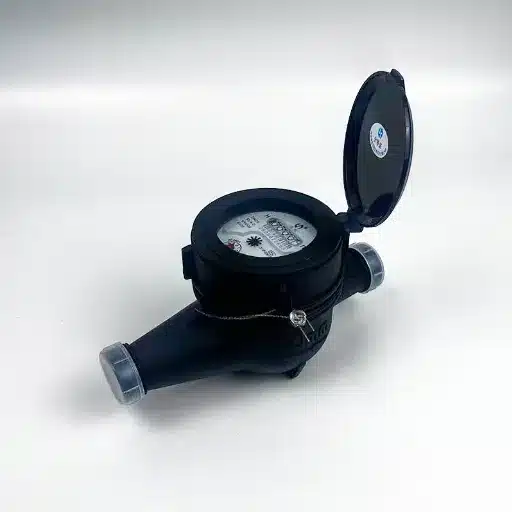
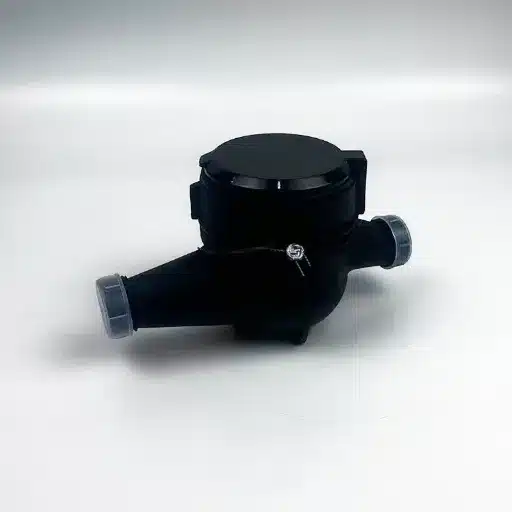
Dry type is the default for residential billing and export. A dry type water meter keeps the gear train out of the water behind a sealed copper or brass can, so the dial stays legible and the mechanism doesn’t corrode. Only the impeller moves in water, which makes it the single wear part in the assembly.
Inside the meter: key components
| Component | Typical material | Function | Failure mode |
|---|---|---|---|
| Body | Forged brass DN15–50; cast iron or stainless for larger | Contains flow passages | Frost cracking, thread damage |
| Strainer | Stainless mesh | Protects the jet ring | Blockage, bypass if damaged |
| Jet ring | Engineered plastic | Distributes flow into jets | Erosion enlarges ports |
| Impeller | POM or ABS | Rotates with flow | Wear, scale, biological growth |
| Gear train | Plastic or brass | Reduces rotation to register speed | Stripped teeth, drag |
| Magnetic coupling | Sealed can, magnets | Transmits drive without a shaft | Tampering, demagnetisation |
| Register | Mechanical rollers or LCD | Displays total volume | Fogging (wet), display failure |
| Calibration screw | Brass | Trims factory accuracy | Disturbance in the field |
Accuracy, R-Values, and ISO 4064
ISO 4064 and OIML R 49 describe every water meter with four flow rates:
- Q1: minimum flow, the lowest rate the meter must register within its error limit.
- Q2: transitional flow, the boundary between the lower and upper accuracy zones.
- Q3: permanent flow, the rate the meter is designed to run at continuously.
- Q4: overload flow, the short-term maximum.
R is Q3 divided by Q1. It describes the width of the accurate range, not the accuracy itself.
| R value | Legacy letter | Lower zone (Q1–Q2) | Upper zone (Q2–Q4) | DN15 Q1 |
|---|---|---|---|---|
| R80 | Roughly Class B | ±5% | ±2% | 31.3 L/h |
| R100 | Between B and C | ±5% | ±2% | 25.0 L/h |
| R160 | Roughly Class C | ±5% | ±2% | 15.6 L/h |
| R200 | Above C | ±5% | ±2% | 12.5 L/h |
Two warnings belong under that table.
The old ISO 4064:1993 Class A, B, and C letters are withdrawn. They don’t convert cleanly to R values, and a datasheet that mixes the systems tells you something about its author. Use R.
And a larger R does not make a better meter. An R160 water meter on DN25 has a Q1 of 39.4 L/h, which is worse in absolute terms than a DN15 at R80. Compare Q1 in litres per hour first, then compare the class.
One more standard matters for US procurement. AWWA C708 covers cold-water multijet meters. It is not interchangeable with AWWA C700, which covers displacement meters. A supplier who quotes C700 for a multi jet product has either mislabelled the meter or misread the standard.
How to choose an R value
Size Q3 from peak design demand. Then set R from the smallest flow you must actually bill, because Q1 is Q3 divided by R, and Q1 has to sit below your drip, leak, and night-flow threshold.
A worked example makes the rule concrete. A DN15 with Q3 of 2.5 m³/h gives a Q1 of 15.6 L/h at R160 and 31.3 L/h at R80. If your tariff needs to capture a 20 L/h trickle, R80 will miss it entirely and R160 will catch it.
Higher R costs more, and a very high R can be more sensitive to particulate because the clearances are tighter. Specify the R your tariff needs. Do not specify the biggest number on the datasheet.
Sizes, Flow Rates, and Applications
| DN | Q3 (m³/h) | Q4 (m³/h) | Q1 at R160 | Typical application |
|---|---|---|---|---|
| 15 | 2.5 | 3.125 | 15.6 L/h | Single dwelling |
| 20 | 4.0 | 5.0 | 25.0 L/h | Apartment, small house |
| 25 | 6.3 | 7.875 | 39.4 L/h | Large dwelling, small shop |
| 32 | 12.5 | 15.625 | 78.1 L/h | Small commercial |
| 40 | 20 | 25.0 | 125.0 L/h | Commercial unit |
| 50 | 25 | 31.25 | 156.3 L/h | Light industrial, multi-unit |
Q4 is 1.25 times Q3 for these sizes. Pressure loss at Q3 should not exceed 0.063 MPa under ISO 4064, and typical measured values sit between 0.025 and 0.063 MPa.
Applications group into five buckets:
- Residential utility billing, the dominant use worldwide
- Apartment and multi-tenant submetering
- Small commercial service connections
- Municipal fleets in developing markets, where cost and dirty-water tolerance matter more than the last percent of accuracy
- Prepaid and AMI builds on a mechanical base
Above DN50 to DN100, the economics shift. Woltmann turbine meters handle high steady flows in mains. Electromagnetic and ultrasonic meters take over where low flow matters or the pipe is large.
Sizing from peak demand to Q3
- Calculate peak design flow from fixture units or occupancy.
- Select Q3 at or just above that peak. Never oversize.
- Confirm Q1 sits below the minimum flow you need to bill.
- Check pressure loss at Q3 stays within 0.063 MPa.
- Confirm PN16 or PN25 and the right temperature class.
Oversizing is the most common specification error. It raises Q1, which means the meter stops seeing low flows, which means the utility stops billing them. A meter that is too big is worse than a meter that is slightly too small.
Installation details that change accuracy
Mount horizontally where the model allows, with the register face up and the flow arrow pointing the right way. Keep the pipe full, and respect the upstream and downstream straight runs in ISO 4064-2. Fit the strainer upstream.
Protect against frost and backflow. Vertical installation is acceptable only where the manufacturer permits it, and only with upward flow so the chamber stays flooded.
A correctly specified meter installed badly under-registers. That is a revenue problem, not a meter problem.
Multi Jet Water Meter vs the Alternatives
| Multi jet | Single jet | Ultrasonic | Electromagnetic | |
|---|---|---|---|---|
| Principle | Jet-driven impeller | Single-jet impeller | Transit-time sound | Faraday induction |
| Moving parts | Yes | Yes | No | No |
| Typical DN | 15–150 | 15–50 | 15–300 | 50–2000 |
| Low-flow accuracy | Good | Moderate | Excellent | Good |
| Pressure loss | Moderate | Moderate | Near zero | Near zero |
| Wear and drift | Gradual | Faster | None mechanical | None mechanical |
| Relative cost | Low | Lowest | 3–5× multi jet | High |
| Particulate tolerance | Good | Moderate | Good | Requires conductive water |
| Native AMR | No, needs retrofit | No | Yes | Yes |
| Best fit | Residential billing | Tight spaces, low cost | Smart AMI, wide range | Large conductive lines |
Multi Jet vs Single Jet Water Meters
Multi jet wins on low-flow accuracy and long-term stability, because the balanced load keeps the bearing and the impeller from wearing unevenly. Single jet wins on unit cost and compactness.
Both are mechanical and both drift with wear. Choose multi jet where billing accuracy and water quality matter. Choose single jet for tight installation spaces and low-cost replacement fleets where the meter is treated as disposable.
Multi Jet vs Ultrasonic Water Meters
An ultrasonic meter has no moving parts. Starting flow is around 1 L/h against roughly 15 to 30 L/h for a mechanical multi jet. Pressure loss is close to zero, and battery life runs 10 to 20 years. It also holds its accuracy across the whole range rather than drifting as a bearing opens.
It costs three to five times as much, and it is more sensitive to entrained air and distorted flow profiles. The decision rule is straightforward: new build or high-value, high-tariff account, specify ultrasonic. Existing fleet with tight capital budget, keep the mechanical meters and retrofit the reading. Our ultrasonic range covers the static option.
Multi Jet vs Electromagnetic and Woltmann Meters
Electromagnetic meters need conductive water, roughly 5 to 20 µS/cm minimum, and they excel from DN50 to DN2000 with no pressure loss. They need power. Woltmann turbine meters suit high, steady flows in mains but have poor low-flow sensitivity.
Multi jet is the economical choice below DN50. Above that, specify by size and flow profile rather than by habit.
Multi Jet Water Meter Strengths and Weaknesses
| Strengths | Weaknesses |
|---|---|
| Low cost per point of accuracy | Moving parts wear and drift |
| Balanced impeller load, even wear | Under-registers at very low flow |
| Tolerates moderate particulate | Grit and scale eventually bite |
| Mature global supply base | Non-zero pressure loss |
| Dry-register tamper resistance | No native electronic output |
| Easy to retrofit with pulse or camera | Impractical above DN50 |
That balance is the honest picture. A multi jet meter is not a premium instrument. It is a cheap, robust, well-understood device that does a specific job well and degrades in a predictable direction.
How they fail in the field
Four failure modes account for most of it.
Sediment and grit erode the jet ring and impeller. The ports enlarge, the jets lose velocity, and registration falls. A 2012 study in Journal AWWA exposed new meters to a sand slug and tracked accuracy through expected life; multi jet was among the most tolerant designs tested, but tolerance is not immunity.
Scale and biofilm build on the impeller and inside the jet ports, adding drag. The meter slows gradually. In hard water this is the dominant failure mode.
Bearing wear raises Q1 over time. The meter still reads correctly at normal flow, which is why a bench test at Q3 can pass a meter that is failing at low flow.
Register issues are separate from metrology. Wet-type dials fog. Magnets can brake or misalign a coupling, which is why anti-magnetic registers and tamper alerts exist.
Maintenance is simple: clean the strainer, verify periodically, and replace when the error exceeds the maximum permissible error. Verification intervals are set locally rather than universally.
China’s JJG 162 sets six years for meters up to DN25. Germany requires six years for cold water. Most US utilities sample-test rather than replace on a fixed cycle.
The Installed-Base Problem: Adding AMR Without Replacing Meters
Here is the commercial reality that follows from everything above.
Roughly 30% of water put into supply is lost as non-revenue water (NRW) before it is billed, according to the World Bank. Some of that is leakage. Some of it is meter under-registration and reading error. Meanwhile the smart water metering market is growing at roughly 10% a year, with estimates clustering between $4.6 billion and $9.1 billion in 2024 depending on how each research firm scopes it.
Utilities and building owners are therefore caught between two facts. They already own millions of accurate mechanical multi jet meters. And they need data from them.
Full replacement is capital-heavy, labour-heavy, and disruptive. It also throws away meters that are still within their accuracy envelope. Retrofitting the reading is the low-capital path, and it’s the one most procurement documents don’t consider.
Three upgrade paths compared
| Camera retrofit | Smart mechanical replacement | Ultrasonic replacement | |
|---|---|---|---|
| Capital per point | Lowest | Medium | Highest |
| Installation disruption | Minimal, no pipe work | Meter swap | Meter swap |
| Time to first data | Days | Weeks to months | Weeks to months |
| Data granularity | Daily to hourly reads | Daily to hourly | Hourly and finer |
| Low-flow leak detection | Limited by meter Q1 | Limited by meter Q1 | Strong |
| Metrology improvement | None | None | Significant |
| Best fit | Existing accurate fleet, tight budget | Mixed-age fleet | New build, high-value accounts |
The honest point about retrofit is that it improves visibility, not metrology. It tells you what the meter already registered, sooner. If the meters themselves are failing, retrofit will faithfully report the wrong number faster.
Camera direct-reading retrofit on an existing fleet
This is where Black Ant’s product differs from most of what the market offers.
A camera module mounts over the existing register and captures images of the dial. It recognises the reading on the device and transmits it over NB-IoT. There is no pipe work, no meter replacement, and no interruption to supply. The meter stays calibrated and verified exactly as it was.
What it unlocks is straightforward. Daily or hourly reads instead of quarterly rounds. Automated billing.
Then the operational side: consumption anomaly alerts when a property starts using water at 3 a. m., and the end of manual reading labour across a dispersed fleet.
What it doesn’t do matters just as much. Resolution is bounded by the smallest dial on the register. It can’t detect flow below the meter’s own Q1, and it adds no valve control.
Wet, fogged, or obscured registers reduce read reliability. And local metrology rules may govern any device fitted to a verified meter, so check the jurisdiction before you deploy at scale.
For a utility with 40,000 installed multi jet meters and no capital for replacement, that is still a compelling trade. You get AMR data across the whole fleet for a fraction of the cost of new meters, and you keep the metrology you already paid to certify.
Our camera direct-reading retrofit for mechanical meters covers that path in detail. If you’re buying new meters rather than retrofitting, the small-diameter residential water meters range is the equivalent.
From meter reads to a metering platform
A retrofit is only useful if the data lands somewhere. The stack runs: camera module, then NB-IoT uplink, then a centralized meter reader aggregating up to 1,024 sub-meters per unit, then an IoT data collection terminal handling RS485, M-Bus, and 4–20 mA inputs, then a BEMS or utility MDM platform.
Which radio carries the data is a separate decision. If you are weighing licensed cellular against private gateways, our NB-IoT vs LoRaWAN water meter guide covers it. The short version: NB-IoT where carrier coverage is good and you want no infrastructure, LoRaWAN where you control the network and need long battery life at high density.
What to Verify Before You Buy
A multi jet water meter is a simple product with a complicated paper trail. The certificate matters as much as the impeller.
| Check | What good looks like |
|---|---|
| Standard and edition | ISO 4064 and OIML R 49 named on the datasheet or certificate |
| Accuracy class | ISO 4064 accuracy class 2 for domestic sizes, with R value stated |
| Flow data | Q1, Q2, Q3, Q4 all given, not just “R160” |
| Pressure loss | Declared at Q3, ideally ≤0.063 MPa |
| Materials | Lead-free brass or bronze; NSF/ANSI 61 and 372 where required |
| Register | Dry or wet, IP rating, pulse output and pulse weight if fitted |
| Temperature class | T30, T50, T70 or T90, matched to the application |
| Test evidence | Type-test report from an accredited laboratory, not a photocopied certificate |
| Warranty and spares | Impeller and register availability, not just a warranty period |
Red flags are consistent:
- A datasheet with no Q1 or Q3.
- A meter described only as “Class B”.
- No error curve.
- A CE mark with no notified-body number where MID applies.
- No potable-water material approval for a product sold into drinking water.
On price, Chinese OEM production at MOQ commonly runs roughly 10to10to17 per unit for DN15 to DN20 brass multi jet meters at volumes around 500 pieces. Treat that as an indicative market range observed in 2026, not a quotation. The gap between that and branded pricing buys certificates, test reports, lead-free material, and support.
If you’re sourcing for a developing market, confirm the water quality and flow profile before you fix a specification. It’s cheaper than discovering the R value was wrong after the first billing cycle.
Frequently Asked Questions
What is the difference between multi jet and single jet?
A single jet directs one stream at the impeller, which loads one side of the bearing and wears unevenly. A multi jet distributes 6 to 12 jets around the circumference, giving balanced load, lower starting flow, and more stable accuracy over life.
Which is more accurate, multi jet or single jet?
Multi jet, at low flow and over time. Both are mechanical and both drift, but the balanced loading means a multi jet holds its accuracy longer. Single jet is cheaper and more compact.
What does R160 mean on a multi jet water meter?
R160 means Q3 divided by Q1 equals 160. On a DN15 with Q3 of 2.5 m³/h, that gives a Q1 of 15.6 L/h. It describes the width of the accurate range, not the accuracy class.
Is Class B the same as R160?
Roughly. The old ISO 4064:1993 Class B corresponds to about R80, and Class C to about R160. The letter grades are withdrawn; R values are the current designation.
Dry type or wet type?
Dry type for residential billing and export. The sealed register stays legible, the gear train stays out of the water, and IP68 protection is standard. Wet type is cheaper and fine for utility water in mild climates.
How long does a multi jet meter last?
Typically 10 to 15 years in clean water service, with accuracy degrading gradually from bearing wear and scale. Verification intervals are set locally, commonly six years for small residential meters.
What size do I need?
Size Q3 from peak design demand, then set R from the smallest flow you must bill. A single dwelling usually needs DN15. A large house or small shop needs DN20 to DN25. Oversizing raises Q1 and loses low-flow revenue.
Can a multi jet meter be used for hot water?
Yes, in hot-water variants rated T70 or T90 with heat-resistant materials and a different register. A cold-water T30 meter used on hot water will fail early.
The Meter You Already Own
A multi jet water meter is the cheapest accurate way to bill a household, and it will stay that way for most of the world’s service connections. It is not obsolete. It is the installed base.
Three things decide whether it serves you well. Specify R from the minimum flow you must bill, not the biggest number available. Size Q3 from peak demand and resist the urge to oversize. Keep grit and air out of the chamber, and verify at low flow rather than only at normal flow.
Then the fourth decision, which most procurement documents skip: if the meters are already in the ground and still accurate, the cheapest route to AMR is reading them, not replacing them.
Black Ant manufactures small-diameter mechanical and smart meters from DN15 to DN25, the category multi jet belongs to, alongside an ultrasonic range, large-diameter electromagnetic meters, and the camera direct-reading retrofit that upgrades an existing fleet without replacing a single meter. We are ISO 9001 certified, CE and RoHS compliant, and fluent in ISO 4064, OIML R 49, AWWA C708, and MID documentation.
Multi jet is one technology in that range, not a standalone flagship. The differentiator is that we can supply the mechanical meter and add optical AMR to the fleet you already own.
If you are specifying multi jet meters, or working out how to get data out of the ones you have, send us the flow profile and the constraint. We will tell you which path makes sense, including when the answer is not our product.







