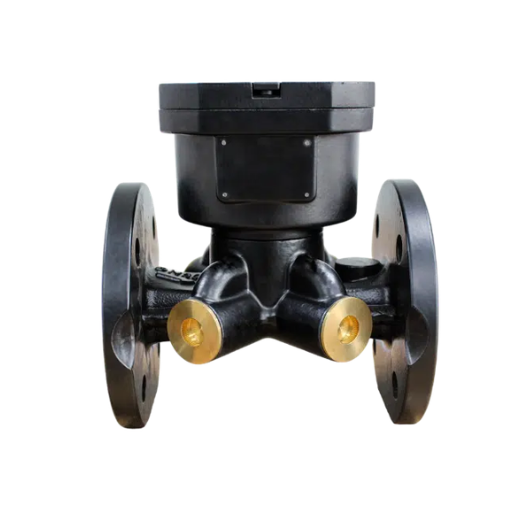
Positive Displacement Water Meters: How They Work
A worn positive displacement water meter doesn’t fail. It keeps turning, keeps billing, and quietly under-reports. A burst main gets fixed the same day. A meter that runs slow can drain a utility’s revenue for a decade before anyone tests it.
That’s why metering engineers care less about how the meter is built than about how it fails. The mechanism explains the accuracy. The wear explains the revenue loss.
This guide covers both: how a fixed-volume chamber counts water, why the nutating disc and oscillating piston behave differently, what R160 means, which failure modes matter, and what to verify before buying. The same meter is a volumetric water meter in Europe, a rotary piston water meter on a Chinese datasheet, and a displacement meter under AWWA C700.
What Is a Positive Displacement Water Meter?

A positive displacement water meter, also called a volumetric water meter, measures volume by trapping a fixed amount of water in a measuring chamber. It counts how many times that chamber fills and empties. Because it counts discrete volumes rather than inferring flow from velocity, it holds accuracy at very low flows.
The naming is the first thing to fix. Positive displacement describes the mechanism; volumetric is the category name in ISO 4064 and OIML R 49. Rotary or oscillating piston is the dominant design in Europe and Asia; nutating disc is the North American design.
They are one family with regional vocabulary. Within the wider set of types of water meters, they are the low-flow specialists.
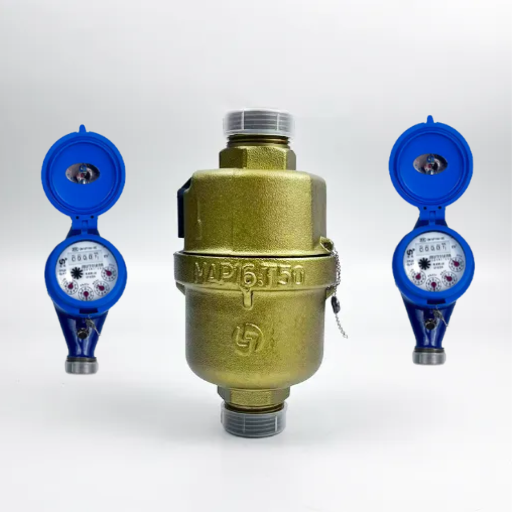
That split matters: a buyer searching for a volumetric water meter and one searching for a positive displacement water meter want the same device. If you already know the type, our brass volumetric water meter shows the specifications in the notation used below.
Not the same as an industrial positive displacement flow meter
“Positive displacement” also describes a broad industrial family: oval-gear, screw, and reciprocating meters for viscous or chemical media. Those are not potable-water billing meters.
| PD water meter | Industrial PD flow meter | |
|---|---|---|
| Media | Potable and clean water | Oil, chemicals, viscous fluids |
| Register | Sealed billing register, pulse/M-Bus | Process output, 4–20 mA |
| Standards | ISO 4064, OIML R49, AWWA C700 | Industrial flow and custody-transfer standards |
| Sizes | DN15–DN50 typical | Application-specific |
If your search led to oval-gear literature, you are in the wrong branch of the family. This article covers the water-billing branch only.
How a Positive Displacement Water Meter Counts Water
A PD meter, short for positive displacement, counts in cycles. Both designs isolate a fixed swept volume, move it through the measuring chamber, and convert the motion into a register count. The geometry differs, and so do the wear points.
The oscillating piston water meter
A cylindrical piston sits eccentrically inside a measuring chamber, with a fixed partition separating inlet from outlet. Water pushes the piston around the partition, and each orbit sweeps a fixed volume. A roller or guide keeps the piston aligned.
The piston drives a magnet through the chamber wall, and the magnet turns a sealed register. No shaft penetrates the body, which is why a dry-dial meter keeps its counter clean and fog-free. The design is compact and holds accuracy to very low flows, but the small piston-to-chamber clearance makes it more grit-sensitive.
The nutating disc water meter
A nutating disc meter mounts a disc on a central ball inside a spherical chamber. A partition prevents the disc from spinning. Instead it wobbles, or nutates: one edge lifts while the opposite edge seats. Each nutation displaces a fixed volume, and a spindle drives the register through a magnetic coupling.
Think of a coin rolling around the rim of a bowl without completing a spin. The disc tolerates slightly more debris than a piston, but it has its own wear points: the thrust roller, the ball socket, and the disc edge. It is also larger and heavier for the same capacity.
Nutating disc vs oscillating piston
| Feature | Nutating disc | Oscillating / rotary piston |
|---|---|---|
| Motion | Disc wobbles on a central ball | Piston orbits around a partition |
| Main wear points | Thrust roller, ball socket, disc edge | Piston roller, partition, chamber wall |
| Grit tolerance | Moderate | Lower |
| Typical R value | R80–R250 | R160–R400, design dependent |
| Common market | North America | Europe, Asia, China |
| Governing standard | AWWA C700 or C710 | ISO 4064 / OIML R49 |
| Typical sizes | 5/8″–2″ | DN15–DN40 |
On clean water and low flows, both designs are excellent. On sandy water, both lose to a multi-jet or a static meter.
Accuracy, R Value, and the Low-Flow Case
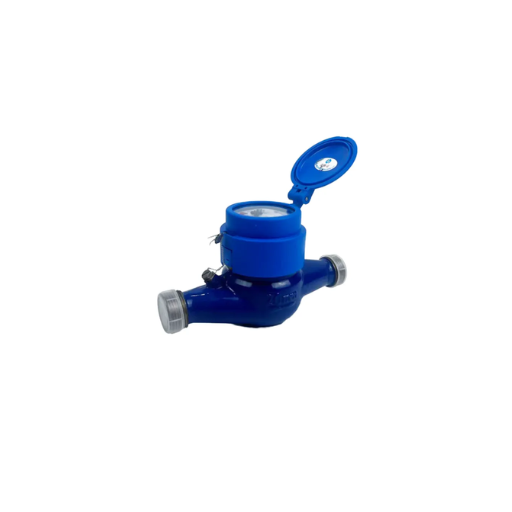
A positive displacement water meter is accurate at low flow because it measures volume directly. A velocity, or inferential, meter estimates volume from a rotor or a sound path, and that estimate degrades as flow falls. A fixed chamber has no such problem until the flow cannot move the measuring element.
Q1 to Q4 and what R160 means
ISO 4064 and OIML R49 describe every meter with four flow rates:
- Q1: minimum flow, the lowest rate the meter must register within its error limit.
- Q2: transitional flow, the boundary between the lower and upper accuracy zones.
- Q3: permanent or nominal flow, the rate the meter is designed to run at continuously.
- Q4: overload flow, the short-term maximum.
R is Q3 ÷ Q1. It’s a range parameter, not an accuracy figure. A meter with Q3 of 2.5 m³/h and Q1 of 15.6 L/h has an R value of 160. The same R160 at DN20 means Q3 of 4 m³/h and Q1 of 25 L/h.
So “higher R” isn’t the same as “more accurate”. A larger meter with a higher R can still have a worse absolute Q1 than a smaller one. Compare Q1 in litres per hour, then compare the accuracy class. Our flow meter turndown ratio guide covers the ratio.
Accuracy classes without the alphabet soup
| System | Class | Lower zone (Q1–Q2) | Upper zone (Q2–Q4) | Notes |
|---|---|---|---|---|
| ISO 4064-1:2024 / OIML R49 | Class 2 | ±5% | ±2% up to 30 °C; ±3% above | Normal billing grade |
| ISO 4064-1:2024 / OIML R49 | Class 1 | ±3% | ±1% up to 30 °C; ±2% above | Only for Q3 ≥ 100 m³/h |
| EU MID 2014/32/EU, MI-001 | No class label | ±5% | ±2% up to 30 °C; ±3% above | CE + M marking via a Notified Body |
| AWWA C700 / C710 | Utility test regime | Defined low-flow test | Defined normal-flow test | US practice; not convertible to R values |
Three warnings belong under that table. First, the old ISO 4064:1993 Class A, B, and C letters are withdrawn. They don’t convert reliably to class 1 or class 2, and they are not an R value. A datasheet that mixes the systems tells you something about its author.
Second, a DN15 residential meter can’t be class 1. Under OIML R49, class 1 is reserved for meters with Q3 of at least 100 m³/h. Domestic PD meters are class 2; a supplier claiming otherwise is either confused or hoping you are.
Third, ±0.5% and ±0.1% claims are not standard accuracy. They are best-case bench results at a favourable flow point, quoted without test conditions. Class 2 permits ±2% in the upper zone and ±5% in the lower zone. Treat a tighter claim as a request for the test report.
The revenue case
Non-revenue water is not only a leakage problem. The peer-reviewed estimate is about 346 million m³ a day, or 126 billion m³ a year, worth roughly 39billionat39billionat0.31/m³. Some is real loss in pipes; some is apparent loss from meter under-registration and data errors.
A meter that stops seeing low flows moves water from billed to unbilled without leaking a drop. That’s why utilities test at Q1, not only at normal flow.
Where Positive Displacement Water Meters Fit, and Where They Don’t
Positive displacement meters dominate residential billing because they are cheap, self-powered, repairable, and accurate at household flows.
Positive displacement meters fit residential customer service (5/8″ and 5/8″ x 3/4″ in North America, DN15–DN20 in Europe and Asia), apartment submetering, light commercial service, and clean process water where a magnetic meter is awkward and a static meter is expensive. Above DN50 the family stops being competitive, and large-diameter turbine and Woltmann meters cover the mains and laterals.
Where another family wins
| PD / volumetric | Multi-jet | Turbine / Woltmann | Ultrasonic | |
|---|---|---|---|---|
| Principle | Fixed chamber count | Jet-driven impeller | Axial rotor | Transit-time sound |
| Low-flow accuracy | Best mechanical | Good | Poor | Excellent |
| Dirty-water tolerance | Low | Moderate | Low | High |
| Straight pipe needed | No | Minimal | Yes, 5–10D | Yes, 5–10D |
| Power required | No | No | No | Yes, battery |
| Typical DN | 15–50 | 15–150 | 50–500 | 15–300 |
| Best fit | Residential low flow | Residential and commercial | High steady flow | Smart AMI, wide range |
A positive displacement meter is the wrong choice for a sandy borehole, a wastewater line, or a site with wide demand swings. Our small-diameter water meters cover the residential alternatives, and the ultrasonic water meter guide covers the static option.
Failure Modes: Why Worn Meters Run Slow
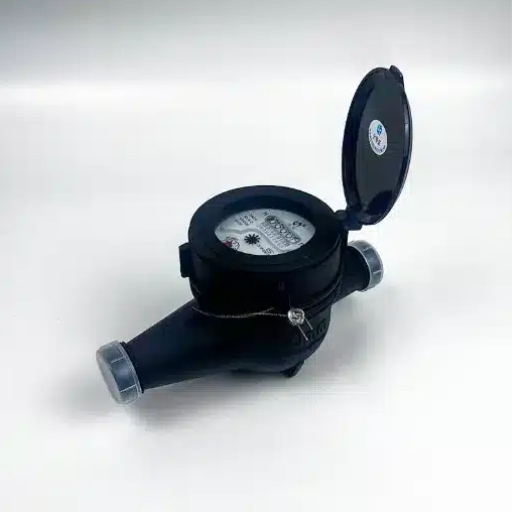
The most important fact about failure is the direction of the error. Wear makes a meter under-register, not over-register.
As the chamber, piston, or disc wears, clearances open and water slips past the measuring element uncounted. The register keeps turning, but less than the true volume.
Field studies put the drift at roughly 0.3–0.5% a year: a Spanish study of 1,210 mechanical meters found accuracy falling with both age and volume passed, and a South African study measured about 0.36% a year (Couvelis and van Zyl, 2015).
At ten years that is a few percent, not twenty. A badly worn or damaged meter can lose far more, and the utility cannot know without a bench test.
That is the opposite of the common belief that an old meter speeds up and overcharges. Over-registration happens, but its causes are different: entrained air, a flow disturbance, or a misread register.
Grit and suspended solids
Sand is the enemy. A 2012 study in Journal AWWA exposed new meters to a slug of sand and tracked accuracy through expected life. The oscillating piston was the worst performer.
Nutating disc and single-jet meters were intermediate. Multi-jet and fluidic-oscillator meters were the most tolerant.
Field evidence matches. Sand scours the chamber wall and enlarges clearances. Debris can lodge between the piston or disc and the division plate, impeding movement. A bench test at normal flow can miss both, which is why low-flow testing matters.
If the supply carries grit, fit a strainer, flush before commissioning, and choose a family that tolerates the water.
Air entrainment and the creeping meter
A fixed chamber counts whatever passes through it, including air. After a main break or a pressure swing, trapped air can shuttle small volumes back and forth across the chamber. The meter creeps with no taps open, and the bill rises.
The diagnostic is simple. Shut the building main and watch the register. If movement stops, the cause is downstream.
If it continues, check for a leak or a pressure fluctuation. Purge the highest and lowest outlets, then fit an air release valve or a spring check valve where the problem repeats.
Air is also why a PD meter can over-register. The chamber doesn’t know water from a bubble. It counts the volume that passes.
Scale, frost, backflow and magnets
Hard water leaves scale on the chamber and piston; the meter slows, then seizes. Freezing water cracks the chamber or body. Reverse flow can drive a register backwards, so fit a non-return valve. External magnets can brake or misalign the coupling, which is why anti-magnetic registers and tamper alerts exist.
Testing and replacement
There’s no universal water meter replacement interval; water quality, throughput, and local rules decide. China’s JJG 162-2019 sets six years for meters up to DN25 and four years for DN32 to DN50. Germany requires six years for cold water. Most US utilities have no fixed interval and sample-test instead.
Fort Smith, Arkansas is the cautionary tale. An internal audit found roughly 570 Zenner positive displacement meters had accuracy problems that went undetected because the city only sample-tested before installation. Sampling incoming stock is not a maintenance programme.
Replacing meters without explaining why carries its own risk. When Yorkville, Illinois changed meters in 2026, residents reported higher bills. The city explained that older meters commonly under-register, so the new readings were not a speed-up.
Kent County, Rhode Island reported an average 8–10% accuracy gain after replacement and investigated 225 complaints out of 9,000 bills. The meter didn’t speed up. It stopped running slow.
Installation, Retrofit, and Buying
Installation rules that actually matter
Positive displacement meters are more forgiving than turbine or ultrasonic meters in one respect: they don’t need long straight pipe runs. Because they measure trapped volume rather than inferring velocity, upstream flow profile has little effect.
The rest matters:
- Flush the line before fitting the meter. Construction debris destroys chambers.
- Fit a strainer where the supply can carry grit, and clean it.
- Mount a piston meter horizontally where possible. A nutating disc is more position-tolerant; vertical installation is acceptable with upward flow so the chamber stays flooded.
- Keep the pipe full, purge air before commissioning, and protect against frost and flooding.
- Fit a non-return valve where backflow is possible, and plan a bypass so testing doesn’t require a shutdown.
- Test at low flow at commissioning, not only at normal flow.
Making a PD meter smart
A pulse output is the cheapest route to remote reading: a reed switch or Hall-effect sensor emits a fixed number of pulses per cubic metre, and a centralized meter reader collects the total for billing. For an installed fleet, a camera direct-reading water meter fits over the existing dial and reads it optically, avoiding replacement of a calibrated meter. The connectivity decision, including NB-IoT vs LoRaWAN, belongs to a separate guide.
What to verify before you buy
A positive displacement water meter is a simple product with a complicated paper trail. The certificate matters as much as the chamber.
| Check | What good looks like |
|---|---|
| Standard and edition | ISO 4064-1:2024, OIML R49, or AWWA C700-24 / C710-24 named on the datasheet or certificate |
| Accuracy class | Water meter accuracy class 2 for domestic sizes; class 1 only where Q3 ≥ 100 m³/h |
| Flow data | Q1, Q2, Q3, Q4 and R value stated, not just “R400” |
| Head loss | ≤0.063 MPa at Q3, or the declared pressure-loss class |
| Materials | Lead-free brass or bronze body; chamber material stated; NSF/ANSI/CAN 61 and 372 where required |
| Register | Dry or wet dial, pulse output, protocol, pulse weight |
| Orientation | Horizontal, vertical, or inclined, with conditions |
| Test evidence | Type-test report to ISO 4064-2 from an accredited laboratory, not a photocopied certificate |
| Warranty and spares | Chamber and register availability, not just a warranty period |
Price bands are wide. As of 2026, branded 5/8″ x 3/4″ meters retail at roughly 120–120–245, or up to about 355withanencodedAMRregister.ChineseOEMproductionatMOQcommonlyruns355withanencodedAMRregister.ChineseOEMproductionatMOQcommonlyruns7–$17 per unit for DN15–DN20 brass piston meters.
The gap is not all margin: certificates, test reports, lead-free material, and support are what the difference buys. To compare these models with the rest of the catalogue, browse the water meter range.
Frequently Asked Questions
Is a volumetric water meter the same as a positive displacement meter?
Yes. Volumetric is the category name in ISO 4064 and OIML R49; positive displacement describes the mechanism. Piston designs dominate Europe and Asia; nutating disc dominates North America.
Nutating disc or oscillating piston: which is better?
Neither, in general. The piston is compact and strong at very low flow but more grit-sensitive. The disc is more position- and debris-tolerant but larger and heavier. Choose by water quality, space, local standard, and the Q1 you must bill.
Do positive displacement water meters measure air?
Yes, and that is a problem. A fixed chamber counts the volume that passes, including bubbles. Purge the line, fit an air release valve where needed, and check for pressure swings before blaming the meter.
Are PD meters more accurate than ultrasonic meters?
At low flow, a good PD meter is excellent for its price. Across a wide range, ultrasonic meters hold a wider accurate band and do not wear in the same way. Comparative utility testing has found differences generally under 3%, in mixed directions. Water quality, flow profile, power, and data needs decide it.
The Meter That Keeps Turning
A positive displacement water meter is the cheapest accurate way to bill a household. It is also a wear item with a known failure direction: as clearances open, it runs slow, and the utility loses revenue without a leak.
Five things decide whether it works in your network: match the design to water quality, size from the flow profile rather than the pipe, specify the class and Q1 you need, keep air and grit out, and test at low flow.
Get those right, and the meter delivers a decade of accurate billing. Get them wrong, and it keeps turning while the revenue disappears.
If you are specifying a volumetric meter for a residential, submetering, or light commercial project, our DN15–DN40 brass volumetric range covers R160 with ISO 4064 testing and optional pulse output. You can also compare our mechanical water meters or talk to our metering engineers about the flow profile before you order.