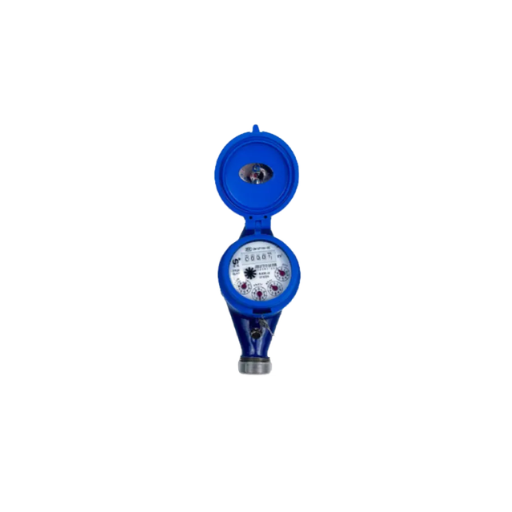
Woltmann Water Meter: Working Principle, Sizing, and Installation
Two DN50 Woltmann water meters can sit on the same drawing and be different machines. One is rated R50, with a minimum flow of 0.5 m³/h. The other is R200, with a minimum flow of 0.2 m³/h. Same pipe size, different meter, and the difference shows up in the first low-flow bill the utility cannot collect.
Priya, a mechanical consultant specifying a bulk meter for a commercial park, learned this the hard way. She picked the body by pipe size and brand, not by ratio. The meter arrived, the building opened, and the night flow she was hired to measure sat silently below the meter’s Q1. Nobody is billed for it.
A Woltmann water meter is an axial velocity meter used for bulk flows from about DN50 upward. Woltmann is also, confusingly, a Chinese manufacturer’s trade name. This guide separates the design from the name, then works through what the types of water meters overview can only summarise: the flow table, the horizontal-versus-vertical distinction, the straight-pipe numbers, and how to verify one in service.
What Is a Woltmann Water Meter?
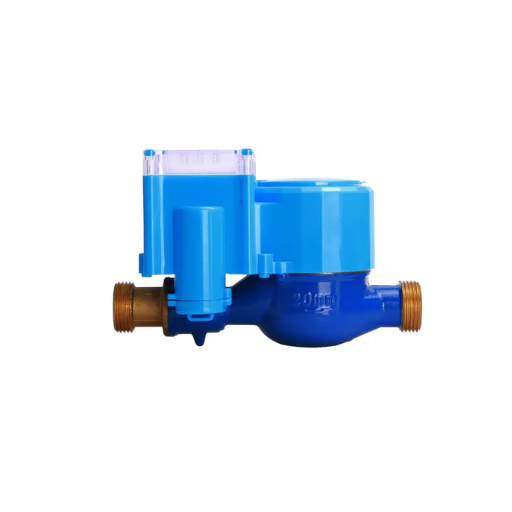
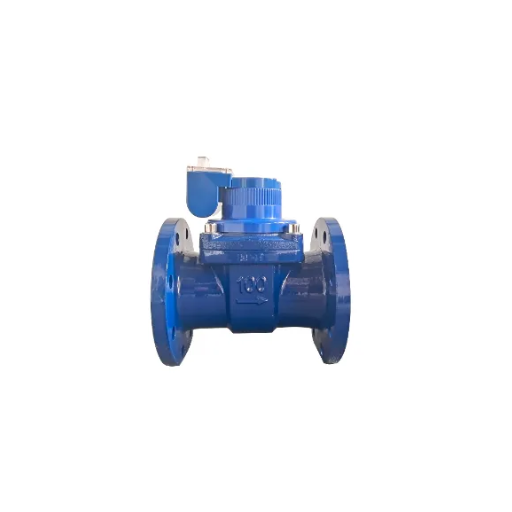
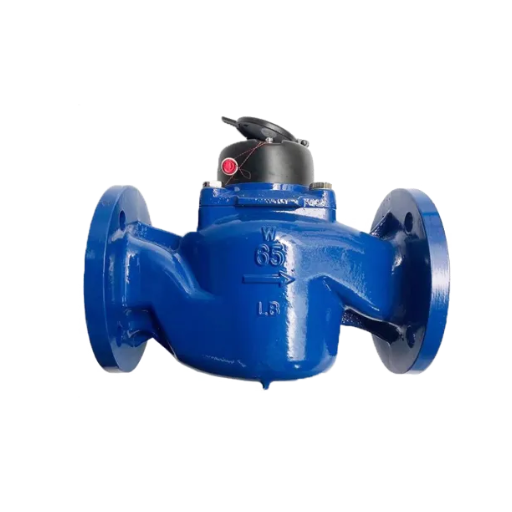
A Woltmann water meter is an axial velocity meter in which a helically bladed rotor is swept parallel to the flow. Rotor speed is proportional to water velocity, and a magnetic coupling or gear train drives a register that totalises volume. It’s the standard bulk meter from roughly DN50 upward.
That definition is the one to remember. It is also, for reasons worth unpacking, not what everyone means when they type the word.
Woltmann, Woltman, helical vane, spiral wing: one meter, five names
The design travels under several names, and page-1 results use them interchangeably. The table maps them so a buyer can stop chasing synonyms.
| Name | What it means | Where you will meet it |
|---|---|---|
| Woltmann water meter | The eponymous name, common in Europe and export catalogues | Zenner, Maddalena, EU datasheets |
| Woltman water meter | The same name with one n dropped | US distributors, older English writing |
| Helical vane water meter | A translation of the Chinese term 螺翼式 | Chinese catalogues and Baidu Baike |
| Spiral wing water meter | Another rendering of 螺翼式 | Black Ant’s own product page |
| Axial turbine meter | The generic mechanical description | Flow Research, engineering texts |
The Chinese translation chain matters because the only genuinely definitional source for this meter online is Baidu Baike’s 螺翼式水表 entry, and it is Chinese-only. An English-speaking buyer reading “spiral wing” and “helical vane” is looking at the same object through two translations of the same two characters.
Where the name comes from: 1790, not 1870
Reinhard Woltmann (1757–1837) described the hydrometric vane for river-flow measurement in 1790; the device became the Woltmannflügel. Some pages date the meter to 1870. That is chronologically impossible, since Woltmann died in 1837, and the 1870 figure belongs to a different instrument tradition. Three sentences is enough: the date matters only because a wrong one is a credibility mark a specifier will notice.
How Does a Woltmann Water Meter Work?
From rotor to register: the measurement chain
The measurement chain is short, and that is the point of the design.
- Water enters the body and passes the strainer.
- Flow turns a helical rotor at a speed proportional to water velocity.
- A magnetic coupling, or on some designs a worm gear, transmits rotation through the sealed register wall.
- A gear train converts rotor revolutions to volume.
- The register totalises.
In a dry-dial design the rotor is the only wetted moving part. Everything else sits behind a sealed wall, which is why a bulk meter can run for a decade without the register being touched.
Horizontal and vertical bodies are different designs
Here is the distinction page 1 gets wrong most often: axis orientation is not mounting orientation.
Zenner’s “Woltman vertical type” WSD has its impeller axis perpendicular to the flow and is installed horizontally. “Vertical” describes where the rotor sits relative to the pipe, not how the meter hangs on the wall.
The two body families trade range against head loss. A parallel-axis body (Zenner WP/WPD) lets water pass almost straight through, so it loses less pressure. A perpendicular-axis body (WS/WSD) forces a double turn, which costs head but makes the meter less sensitive to an upstream bend. The trade is visible in Black Ant’s WS series: the horizontal body is R50, and the vertical body of the same nominal size is R200.
If you are reading below DN50, you are in small-diameter multi-jet meter territory, not Woltmann territory.
Woltmann vs multi-jet: the DN50 crossover
| Meter | Principle | Typical DN | R range | Best use |
|---|---|---|---|---|
| Multi-jet | Tangential jets drive an impeller | DN15–DN50 | R100–R250 | Residential, light commercial |
| Woltmann | Axial helical rotor | DN50–DN300+ | R50–R200 | District mains, bulk transfer |
| Compound | Low-flow element plus turbine | DN50–DN300 | Wide combined range | Wide night-to-peak swings |
The rule of thumb: multi-jet or rotary to DN50, Woltmann above, compound where flow varies widely.
Woltmann vs Turbine: One Design, Many Names
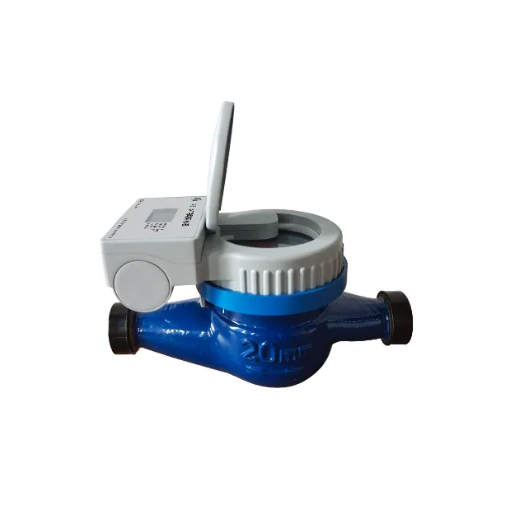
Woltmann is a turbine. It’s the axial subtype. The article says so plainly rather than pretending the trade observes a clean line it does not.
Why the trade uses the names interchangeably
Clark labels a category “Turbine/Woltmann Water Meters”. The supplier water-meters. com writes “woltman style turbine meters”. Flow Research lists Woltman as one of ten turbine types while treating the helical vane as a separate two-blade design. This is not sloppiness to be corrected. It is the vocabulary a buyer will actually meet.
When turbine means something else
Not every “turbine water meter” is a Woltmann, and three counter-examples show the boundary. Itron’s Flostar M is a single-jet meter rated to R630 under MID. AW-Lake’s HM-F is an industrial process meter for oil and fuel, not potable water. Neptune’s HP turbine page never once says Woltman. A reader searching turbine water meter may need none of these.
What to specify instead of a name
A name does not survive a tender. Six numbers do.
- Q3, the permanent flow rate.
- R = Q3/Q1, the flow range.
- DN, the nominal bore.
- Pressure-loss class (p63, p40, p25).
- Temperature class.
- Materials and connection standard.
Specify those, and any honest supplier can bid the right meter regardless of what they call it.
Flow Rates, R Values, and Accuracy Classes
Q1, Q2, Q3, Q4 in plain English
OIML R49 defines four flows, and every Woltmann datasheet hangs off them.
- Q1 is the minimum flow: the lowest rate at which the meter must stay within its maximum permissible error.
- Q2 is the transitional flow that divides the upper and lower accuracy zones.
- Q3 is the permanent flow: the highest rate within rated operating conditions.
- Q4 is the overload flow: short-period, with metrological performance preserved afterward.
The arithmetic is fixed. R = Q3/Q1, Q2/Q1 = 1.6, and Q4/Q3 = 1.25. The R value is chosen from a series, 40, 50, 63, 80, 100, 125, 160, 200, 250, 315, 400, extensible only upward.
What R50 and R200 actually mean
R is a range ratio, not an accuracy figure.
R50 means the meter can resolve a flow one-fiftieth of its permanent rating. R200 means one-two-hundredth. A higher R costs more, usually carries more head loss in a mechanical body, and is more sensitive to particulate. When a datasheet prints R200, it is telling you how low the meter reads, not how accurately.
The flow table page-1 results never publish
This is the section no competitor can copy, because it comes from Black Ant’s own WS series spec sheet.
| Body | DN | Q1 (m³/h) | Q2 (m³/h) | Q3 (m³/h) | Q4 (m³/h) | R = Q3/Q1 | Velocity at Q3 (m/s) |
|---|---|---|---|---|---|---|---|
| Horizontal | 50 | 0.5 | 0.8 | 25 | 31.25 | 50 | 3.54 |
| Vertical | 50 | 0.2 | 0.32 | 40 | 50 | 200 | 5.66 |
| Horizontal | 300 | 20 | 32 | 1000 | 1250 | 50 | 3.93 |
| Vertical | 200 | 2 | 3.2 | 400 | 500 | 200 | 3.54 |
Q2 is computed as 1.6 × Q1 and Q4 as 1.25 × Q3 per OIML; velocity is derived from Q3 and the nominal bore. One honesty note: the vertical DN50 rating implies a velocity around 5.7 m/s at Q3, well above the 3.5–3.9 m/s of the other rows. Treat it as a body-specific rating and confirm it against the datasheet before relying on it.
The full range, horizontal DN40–DN300 and vertical DN50–DN200, lives on the WS series spiral-wing water meter page. See it before you specify.
Class 2, MID, and why the class labels disagree
Three class systems collide on a Woltmann datasheet, and they are not the same thing.
- OIML class 2 is the realistic mechanical rating: ±2% in the upper zone (0.1–30 °C), ±3% above 30 °C, and ±5% in the lower zone.
- OIML class 1 (±1% upper, ±3% lower) is in practice a static or electronic rating. A mechanical Woltmann is declared class 2.
- MID MI-001 has no class labels at all. It sets one MPE set: ±2% for water at or below 30 °C and ±3% above 30 °C in the upper zone, ±5% in the lower zone, at any temperature, with Q3/Q1 at least 40.
The legacy A/B/C letters are withdrawn and not reliably convertible. Do not map any of these onto AWWA C701, which uses its own limits.
Head Loss and Pressure Class
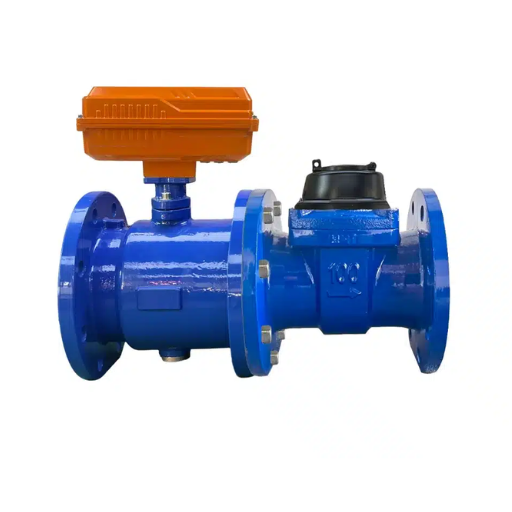
A pressure-loss class is a ceiling anywhere between Q1 and Q3, not a value measured at Q3. Once you hold that, the horizontal-versus-vertical difference and the Q4 consequence both follow.
p63, p40, p25: what the class means
| Class | MPa | Bar | What it costs you |
|---|---|---|---|
| p63 | 0.063 | 0.63 | The loosest common class |
| p40 | 0.040 | 0.40 | Middling; common on EU bulk meters |
| p25 | 0.025 | 0.25 | Low-loss; some DN50 variants |
| p16 | 0.016 | 0.16 | Tight |
| p10 | 0.010 | 0.10 | Tightest |
Two notes from OIML matter. A flow straightener is not counted as part of the meter, so its own loss sits outside the class value. And the peak loss need not occur at Q3.
Horizontal vs vertical: the 0.01 vs 0.06 MPa split
One encyclopedia gives roughly 0.01 MPa for the horizontal type and 0.06 MPa for the vertical type, at Q3. It is a single source stated at one operating point, but it matches the design logic: a perpendicular rotor obstructs more. Present it as one figure, not a measured comparison.
Why delta-p at Q4 matters more than delta-p at Q3
Pressure loss rises roughly with the square of flow. At Q4, which is 1.25 × Q3, that is about 1.56 times the value at Q3, even though Q4 sits outside the declared band. For pump sizing and gravity irrigation, the Q4 number is the one that decides the pipe.
Sizing a Woltmann Water Meter
Five steps from peak demand to Q3
- Calculate peak design flow and pick Q3 at or just above it.
- Check Q1 against the smallest flow you must bill, night flow, drip, leak.
- Check Q4 against fire flow or surge.
- Check delta-p at Q3 and the resulting velocity.
- Choose R from the minimum billable flow, not the biggest number on the datasheet.
Worked example: DN150 at 250 m³/h
One supplier guide presents a DN150 meter at 250 m³/h permanent flow with a 50:1 turndown, and stops there. Interrogate that figure and it falls apart. Through a DN150 bore, 250 m³/h is about 3.9 m/s, and a 50:1 ratio implies Q1 = 5 m³/h. Neither number appears on the source page, so the reader cannot tell whether 250 m³/h is a continuous or an overload rating. That is the lesson: a headline flow without a velocity is not a specification.
Oversizing and undersizing both cost money
Oversizing loses low-flow revenue and pushes Q1 above the leak you needed to see. Undersizing raises delta-p, wear and noise, and puts the meter near Q4 in normal service. The supplier guide that supplied the 250 m³/h figure warns against selecting on pipe diameter alone, a warning worth repeating. For the full DN40–DN300 horizontal and DN50–DN200 vertical range, the large-diameter Woltmann water meters page carries the flow table in full.
Installation and Commissioning
Straight pipe: approved class vs recommended length
The single rule that resolves every conflicting number: the manufacturer’s declared flow-sensitivity class wins.
OIML defines the classes: upstream U0/U3/U5/U10/U15 means 0/3/5/10/15 × DN, and downstream D0/D3/D5 means 0/3/5 × DN. An S suffix means a flow straightener is required.
| Source | Upstream | Downstream | What the number is |
|---|---|---|---|
| OIML R49-1 | U0–U15 | D0–D5 | The normative framework the manufacturer declares against |
| Zenner WSD/WPD | U0 approved | D0 approved | No straight run required for these models |
| Zenner manual | 5 × DN | 2 × DN | Recommended even though approved at zero |
| Maddalena WMAP EVO | U as marked on dial | D as marked | Read the dial; “S” means a straightener is mandatory |
| Chinese field practice | 8–10 × DN | not stated | Conservative upstream default |
| Baidu Baike | 5D | 2D | Encyclopedia figure, matches EU recommendation |
If the datasheet is silent, specify 5–10 × DN upstream and 2–5 × DN downstream, and say it is a default for an undeclared meter. If the datasheet declares U0/D0, the straight run is not required but is still recommended.
Orientation, air, and the highest-point mistake
A horizontal body and a vertical body are different machines, as covered above. When a body is installed vertically, flow must be bottom-to-top, with the register up. The meter must be completely filled with water under normal conditions. That’s OIML, and it’s the requirement that explains the air advice.
Zenner’s wording is that the meter should not be installed, where possible, at the highest point, so that air bubbles cannot form. The advice to install in the lowest part of the network is Maddalena’s, not Zenner’s. Keep the attributions straight.
Strainer, bypass, valves, and check valve
A strainer or filter may be required at the inlet, OIML’s wording, not “manufacturers require.” Zenner says the meter should be protected by a filter if necessary. Write it that way. Then add the rest: a gate valve upstream, a drain, a bypass where one inlet serves domestic plus production plus fire, and a check valve where reverse flow is possible. Black Ant’s WS series carries an integrated strainer, which removes one fitting from the spec.
Commissioning sequence
Nobody on page 1 covers what happens after the meter is bolted in.
- Flush the line before fitting the meter.
- Fill slowly.
- Release air from the pipeline and the meter.
- Leak-test at the outlet.
- Record the initial reading and the installation date.
Accuracy in Service: Failure Modes, Verification, and Rebuild vs Replace
Why it reads low at low flow
Below Q1 no MPE applies and the error is unbounded in either direction. In practice the rotor usually stalls rather than producing a defined negative error. Zenner’s DN50 starts up at 50 L/h against a Q1 of 156 L/h; Maddalena’s starts at 125 L/h against 400 L/h. So a meter that “reads low” at night may simply not be reading. Check for debris on the rotor, bearing wear, and an upstream valve throttled until the profile collapses.
Why it over-reads: air, not magic
Entrained air is the over-registration cause, because the rotor counts air as if it were water. That’s why OIML requires a full pipe and why the air-bleed advice exists. The symptom is a bill higher than the sum of the downstream meters, and the fix is air release, not recalibration.
Debris, wear, and tampering
Debris and bearing wear degrade accuracy over time. Magnetic tampering and wet-dial fogging are the other field failures, and liquid-sealed counters are common on Chinese LXLC-type meters, so “dry dial” is not a universal assumption. On reverse flow, this WS series is not approved for backflow; but the standard does permit declared reverse-flow measurement with the same MPE, so the restriction is a series property, not a design law.
Verify, rebuild, or replace
Three routes exist. A gravimetric bench verifies to the standard. An in-field comparison against a reference meter is cheaper and rougher. China’s verification interval is two years.
When accuracy drifts, a removable measuring cartridge changes the economics: Zenner, Maddalena and Black Ant all build the element to be swapped without cutting the body out. Close on the field truth: a master meter and the sum of its customers won’t agree, and the difference isn’t all leakage.
| Symptom | Likely cause | Check |
|---|---|---|
| Reads low at night | Flow below Q1; rotor stalled | Q1 vs actual minimum flow |
| Reads high overall | Entrained air | Air bleed, full-pipe condition |
| Drift over years | Debris, bearing wear | Bench verification |
| Fogged register | Failed seal | Replace register |
| No reading | Magnetic coupling fault or tamper | Bench test, tamper seal |
Woltmann vs Electromagnetic vs Ultrasonic, and the Smart Retrofit Path
Comparison table
| Attribute | Woltmann | Electromagnetic | Ultrasonic |
|---|---|---|---|
| Principle | Axial rotor | Faraday induction | Transit time |
| Moving parts | One rotor | None | None |
| DN range | DN50–DN300+ | DN25–DN2000 | DN15–DN3000 |
| Turndown | R50–R200 | R100–R250 | R250–R500+ |
| Starting flow | ~50–400 L/h | Very low | ~1 L/h |
| Head loss | Low–moderate | Near zero | Near zero |
| Power | None (mechanical) | Required | Battery |
| Particulate tolerance | Needs strainer | Excellent | Good, air-sensitive |
| Relative cost | Lowest per DN at steady flow | High | High |
| Communications | Add-on only | Native | Native |
Decision rules by application
District main, bulk transfer or plant intake: Woltmann. DMA, night flow or leak detection: ultrasonic. Wastewater, gritty or conductive: electromagnetic. Irrigation: Woltmann or electromagnetic.
Black Ant makes the static options too, and the ultrasonic water meters page is the hand-off when low-flow sensitivity is the deciding factor.
Keep the meter, add the data
The cheapest AMR path usually ignores the meter entirely. A camera direct-reading retrofit photographs the existing register. Pulse output, NB-IoT or 4G moves the reading. A centralized meter reader aggregates up to 1,024 sub-meters, and an IoT data collection terminal sits between the meters and the utility platform.
Say it plainly: retrofit improves visibility, not metrology. It cannot detect flow below Q1, and it does not upgrade accuracy. What it does is turn an installed mechanical fleet into a read one, which is the cheaper of the two problems.
Frequently asked questions
What is a Woltmann water meter?
An axial velocity meter with a helical rotor swept parallel to the flow, used for bulk metering from about DN50 upward.
Is a Woltmann meter the same as a turbine meter?
Yes, with a boundary. Woltmann is the axial turbine subtype; “turbine” also covers single-jet and industrial process meters that are not Woltmanns.
Can a Woltmann water meter be installed vertically?
Only a vertical body, and it must flow bottom-to-top. A horizontal body must not be turned upright.
How much straight pipe does it need?
The manufacturer’s declared U/D class wins. Undeclared, default to 5–10 × DN upstream and 2–5 × DN downstream.
Why does it read low at low flow?
Below Q1 the rotor usually stalls. It’s not under-reading; it’s not reading.
Is a Woltmann heat meter a water meter?
No. A Woltmann heat meter measures water volume inside a thermal-energy meter; billing heat is a separate metrology, and volume alone is not it.
The Meter You Already Own
Five takeaways settle it. A Woltmann water meter has five names and one mechanism. Horizontal and vertical are different bodies, not two ways to mount one meter. R is a range ratio, not an accuracy figure. The declared U/D class beats every straight-pipe rule you were taught. And below Q1, the meter is not reading low; it is not reading.
If the fleet already exists, the cheapest route to data is reading the meters you own rather than replacing them. Start with the WS series flow table, then look at the camera retrofit path. Either way, specify a Woltmann water meter by Q3 and R, not by name. To learn more about Multi Jet Water Meter: Working Principle and AMR Retrofit, please refer to our accompanying guide.