NB-IoT vs LoRaWAN for Municipal AMI: A City-Wide Smart Water Metering Guide
A city that cannot read its own meters is billing on guesses. Roughly 30% of the world’s treated water vanishes to leaks, theft, and aging meters before anyone is paid for it, a $39 billion annual loss utilities record as non-revenue water. When Priya’s utility in a 400,000-resident city checked its records last year, 21% of its water was unaccounted for and a third of its meters had not been read in months. Her board approved a city-wide municipal AMI program. The next question is the one this guide answers: which radio should carry the city’s meter data for the next 20 years?
Municipal AMI means two-way smart water metering at city scale. It links smart meters, a connectivity layer, a head-end system, and a meter data management platform that feeds billing and analytics. NB-IoT and LoRaWAN are the two LPWAN standards that dominate these deployments. This guide compares NB-IoT vs LoRaWAN for municipal AMI, maps the full architecture, and gives you the case studies and tender language to specify a network that fits your city. Need the protocol basics first? Our full NB-IoT vs LoRaWAN water meter connectivity guide covers them.
What Is Municipal AMI, and Why Cities Are Deploying It Now

Advanced Metering Infrastructure for a water utility is a city-wide network that measures consumption, transmits it automatically, and closes the loop with billing and analytics. AMI is two-way, unlike automated meter reading (AMR), which only pushes readings one way. That’s why AMI, not AMR, backs every serious municipal rollout today.
From Manual Reads and AMR to Two-Way AMI
Manual walk-by reading gives a city four data points a year. Drive-by AMR gives one a month. Fixed-network AMI moves the fleet to daily or hourly interval data and removes the meter reader entirely. In Europe and North America, installed water AMI endpoints reached 79.1 million in 2025 and should nearly double to 154.5 million by 2031, per Berg Insight. The shift is no longer incremental. It’s the operating model of the modern municipal utility.
The Business Case: NRW, Billing Accuracy, and Labor
Three wins drive the financial case. Non-revenue water: meters lose 1 to 3% accuracy per year, 23% of meters in a mid-size fleet under-read by more than 3%, and worn mechanical meters under-register by 5 to 15%. Billing accuracy: interval data ends estimates, which is how Georgetown Municipal Water and Sewer Service reported a 10% revenue increase. Labor: the City of Sheridan, Wyoming cut meter-reading hours about 65% and reached a 99.6% daily read rate across 10,000 connections.
The Regulatory Push Is Accelerating
Regulators are forcing the timeline. Ofwat’s AMP8 underwrites Severn Trent’s million-meter AMI contract. AWWA M36 audits and EPA WIFIA loans push US utilities toward measured consumption. China targets non-revenue water below 9%. Municipal AMI is now a compliance requirement, not a discretionary upgrade.
The Components of a Municipal AMI System
A municipal AMI is a chain of four layers, and the weakest link decides the whole. The architecture between the meters and the dashboard is where projects succeed or fail.
Smart Water Meters: From Residential to Large-Diameter Mains
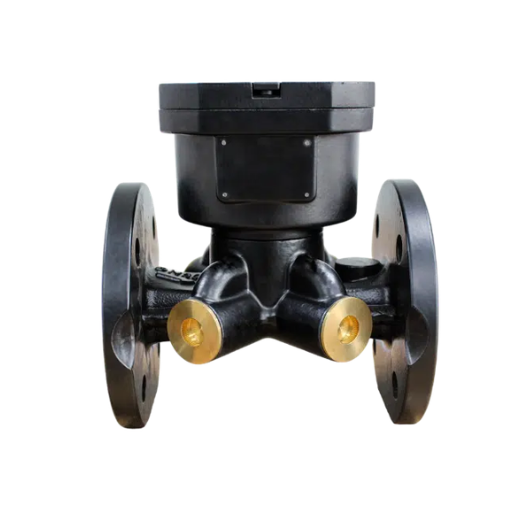
Fleets span two very different products. Residential and small commercial meters from DN15 to DN25 cover most accounts. DN50 to DN500 large-diameter water meters sit on district boundaries and bulk supply points as master meters that reconcile district totals against customer meters. Ultrasonic technology is replacing mechanical meters in both roles because it reads the low flows mechanical meters miss. A Black Ant ultrasonic water meter starts at 1 L/h, holds ±0.1% accuracy across a 100:1 turndown, and runs 10 to 20 years on battery.
The Connectivity Layer: NB-IoT vs LoRaWAN
Every meter must phone home, and the radio it uses sets coverage, cost, and control for the network’s 20-year life. This is the layer this guide is built around. The two serious candidates are NB-IoT, a licensed cellular standard run by carriers, and LoRaWAN, an unlicensed ISM-band protocol on privately owned gateways. Running both is the emerging pattern at the top of the market.
Head-End System, MDM, and Billing Integration
The top of the chain turns radio packets into bills. A head-end system (HES) ingests data from every meter and protocol. A meter data management (MDM) platform validates and estimates readings before release. The customer information system (CIS) prices and invoices them, and a customer portal shows users their own usage. In dense districts, centralized meter readers that gather up to 1,024 sub-meter points per unit before a single uplink are the standard building block.
NB-IoT vs LoRaWAN for Municipal AMI: Side-by-Side

Both standards are proven at city scale. They differ in who owns the network, what it costs, and where each penetrates best.
NB-IoT: Licensed Cellular, Carrier-Managed, Proven at Chinese Scale
NB-IoT runs on licensed spectrum over existing carrier infrastructure. Deploy meters with NB-IoT modules and SIMs, and the carrier network carries the traffic. There is no gateway infrastructure to buy, and licensed spectrum means no interference from other band users. Deep indoor and underground penetration is its signature strength, backed by SIM authentication. The trade-offs are recurring per-connection costs and dependence on a carrier’s coverage and roadmap. China proves the model at scale: it added 31.2 million smart water meters in 2025, and NB-IoT took 79% of purchases. See how NB-IoT smart water metering works for the architecture.
LoRaWAN: Private Gateways, Utility-Owned, City-Scale Coverage
LoRaWAN uses unlicensed spectrum and gateways the utility controls itself. No SIMs, no recurring carrier fees, and complete data sovereignty. A few gateways cover a whole city: Nuremberg reads 21,300 ultrasonic meters through just 30 gateways for a city of roughly 500,000 residents. The trade-offs are gateway capital cost and the burden of running an RF network. The LoRaWAN AMR/AMI architecture guide covers gateway density and scaling.
Side-by-Side Comparison Table
| Criterion | NB-IoT | LoRaWAN |
|---|---|---|
| Spectrum | Licensed cellular | Unlicensed ISM band |
| Network ownership | Carrier-managed | Utility-owned private |
| Infrastructure to deploy | None (carrier coverage) | Gateways and concentrators |
| Cost model | Recurring SIM opex per meter | Gateway capex plus network operations |
| Indoor/underground penetration | Excellent, deep basements and pits | Good, weaker past roughly 20 dB concrete |
| Battery life | 5 to 15 years with PSM/eDRX | 10 to 20 years |
| Data control | Carrier SLA and roadmap | Full utility data sovereignty |
| Deployment speed | Fast where the carrier covers | Requires RF planning and gateway rollout |
| Best city profile | Dense urban, deep basements, no private infra | Dispersed or rural, utility wants network ownership |
Security differs by path. NB-IoT leans on carrier SIM authentication; LoRaWAN on network- and application-layer encryption. The smart water meter security posture across the four layers compares them in depth. If you are choosing endpoints, ultrasonic water meters with NB-IoT or LoRaWAN connectivity let you keep one meter body and pick the radio per district.
City-Wide Coverage: The Criterion That Decides the Network
Most utilities pick a radio before they know where their meters live. That ordering is the most common mistake in municipal AMI.
Basements, Meter Pits, and Deep Indoor Penetration
Coverage is decided by concrete. In a University of South Africa study with Rand Water, NB-IoT kept packet delivery above 0.96 under 30 dB of concrete attenuation. LoRaWAN reliability fell below 0.85 past 20 dB. Marcus, an AMI program manager at a southern US utility, saw this in 2024. His downtown meters sat in concrete pits and garage basements, and his private gateway network heard barely two-thirds of them. More gateways would have blown the district budget. He moved the deep-underground sites to NB-IoT and kept LoRaWAN for surface and rooftop meters. The project went from a 34% coverage shortfall to a 99% read rate in one quarter.
Dense Urban Cores vs Rural Fringes
A city is rarely one geography. The dense core, with basements, garages, and high-rise meter rooms, favors NB-IoT’s depth. The rural fringe, with scattered farms and no carrier coverage, often favors a private LoRaWAN gateway the utility owns. The coverage validation and RF planning methodology shows how to test both before committing, and it is the step most tenders skip.
How China Solved It: NB-IoT at Municipal Scale
China is the world’s largest municipal smart-metering program and the NB-IoT proof at national scale. It added 31.2 million smart water meters in 2025, pushing penetration past 41%, with NB-IoT at 79% of purchases and 80% of 2026 tenders. Projects run large: Shenzhen’s retrofit alone was 85 million yuan, Fujian Zhangzhou’s 62 million, Hangzhou Xiaoshan’s 38 million. The model couples deep urban coverage with a national NRW target below 9%. International utilities can study it as a proven architecture, not a pilot.
Carrier Network vs Private Network: The Economics of Ownership
The cost question isn’t which radio is cheaper per meter. It’s who owns the network and what that costs over a decade.
NB-IoT: SIM Opex, No Infrastructure, Carrier Dependency
NB-IoT means zero infrastructure and a recurring cost per meter for the fleet’s life. There are no gateways to mount, power, or maintain, which collapses the operational burden. The price is dependency. Coverage, reliability, and upgrades follow the carrier’s roadmap, and the SIM bill compounds across hundreds of thousands of endpoints.
LoRaWAN: Gateway Capex, Private Data Control, Network Management
LoRaWAN means upfront gateway and concentrator capex, then control. Utility-owned infrastructure keeps meter data on your network, and a mature gateway fleet carries no per-meter fee. The price is running an RF network: propagation studies, gateway siting, backhaul, and fault monitoring are yours. The total cost of ownership model for water meter connectivity runs the 10-year comparison.
Hybrid Models and Network-as-a-Service
A third path exists. Network-as-a-service (NaaS) and metering-as-a-service (MaaS) let a utility buy the outcome, not the infrastructure, removing the capital barrier. Western Municipal Water District runs its LoRaWAN AMI as a service and cut water loss from 12% to 3.5% with a 99% read rate on 24,000 accounts. The largest municipal contract of the decade is explicitly hybrid. Severn Trent’s £200 million program with Netmore will deploy 1 million AMI meters by 2030 across LoRaWAN and NB-IoT. The four meanings of hybrid and the patterns that work give you the design framework.
Integrating Municipal AMI with Utility Operations: HES, MDM, and CIS

The radio only matters if the data lands in the billing system. This software layer is where meter manufacturers rarely go.
The Head-End Problem: Multi-Protocol Ingestion
A real city never runs one protocol forever. It adds districts, acquires systems, and inherits legacy M-Bus and RS485 concentrators. The head-end must ingest them all into one data model. Black Ant’s IoT data collection terminals accept RS485, M-Bus, and 4-20mA from any meter and uplink over NB-IoT or LoRaWAN, so a legacy wired district joins the AMI without replacing its meters.
Meter Data Management: Validation, Estimation, and Billing
Raw reads are not billing data. The MDM layer validates each read, estimates missing intervals, flags anomalies, and only then releases records to the CIS. Without it, a city billing on estimates defeats the purpose of AMI. Specify the HES-to-MDM-to-CIS handoff as a deliverable, not an assumption.
From Meter Data to the Customer Bill and Portal
The loop closes with the customer. The CIS prices the validated reads, generates the invoice, and feeds a customer portal where residents see hourly usage, get leak alerts, and spot anomalies. The result is fewer estimate disputes and lower call-center volume. For district analytics, Black Ant’s edge data acquisition computers process local meter data at the edge with 10 to 50 ms latency, alerting on leaks and tamper even where cloud connectivity is intermittent.
Real-World Municipal AMI Deployments
The numbers are the argument. These deployments are the proof.
Severn Trent and Netmore (UK): 1 Million Meters, LoRaWAN Plus NB-IoT
Netmore’s £200 million contract with Severn Trent is the definitive 2026 proof point. It will deploy 1 million AMI meters by 2030 across a dual-protocol architecture: LoRaWAN meters from Itron and Diehl paired with Vodafone NB-IoT, targeting 16% leakage and 7% consumption reduction under AMP8. A utility this scale chose both radios. That tells you how the largest cities are converging on hybrid.
Western Municipal Water District (US): Water Loss From 12% to 3.5%
Western Municipal Water District in California runs its LoRaWAN AMI as a service. It cut water loss from 12% to about 3.5% across 24,000 accounts, with a read rate above 99%, per the Neptune case study. It’s the strongest utility-owned-network argument in the industry.
Nuremberg (Germany): 30 Gateways for 21,300 Meters
N-ERGIE reads 21,300 ultrasonic meters through 30 gateways for about 500,000 residents, and the mioty/LoRaWAN hybrid network scales to 80,000 without new gateways. It’s the density model that makes private-network economics work at city scale.
China’s Municipal Rollouts: NB-IoT at National Scale
Individual Chinese cities show the NB-IoT pattern. Shenzhen’s retrofit was 85 million yuan, Fujian Zhangzhou’s 62 million, Hangzhou Xiaoshan’s 38 million. China Telecom’s elderly-monitoring program even reads household meters down to 0.01 cubic meters to detect a resident in distress. An AMI network serves billing and social programs alike.
Emerging Markets: Mexico City, Africa, and the Middle East
The fastest-growing municipal AMI markets are where European incumbents are priced out. Mexico City put 10,000 ultrasonic terminals on LoRaWAN and drove double-digit revenue growth by ending its manual-reading bottleneck. African utilities, with non-revenue water above 40% in many cities, deploy NB-IoT and LoRaWAN AMI as the cheapest fix. Singapore’s PUB is phasing in 300,000 smart meters across LoRaWAN, NB-IoT, and 4G/5G. These are the markets where a manufacturer building both radios, with regional bands and private-label sourcing, makes the case viable.
How to Specify a Municipal AMI: Tender Language and Requirements

The connectivity decision is made in the specification document. Here is the tender language real municipalities use.
Network and Connectivity Requirements
Write the network requirement to match the decision. Ovilla, Texas requires direct cellular NB-IoT with no collectors or repeaters, forcing a carrier-managed architecture. Grand Forks, North Dakota requires a propagation study for any gateway network, forcing RF validation before award. Specify band support, redundancy for critical areas, and a network-availability commitment. If you expect a mixed fleet, require the head-end to ingest both NB-IoT and LoRaWAN before you ask for prices.
Endpoint Requirements: Battery, Accuracy, Interoperability
The endpoint spec carries the long-term cost. Danbury, Connecticut demands a 20-year battery warranty and read accuracy above 98%. Require multi-vendor interoperability, retrofit compatibility, and tamper, reverse-flow, and low-flow alarms as standard. IP68 matters for pit installations, and certified battery life beats any marketing claim.
Software and Integration Requirements
Specify the platform as a deliverable. Require a cloud MDMS with a published CIS and billing interface, validation and estimation logic, DMA analytics, a customer portal, and remote disconnect. Demand proof of head-end integration with your existing CIS before pilot, not after.
Pilot, Testing, and Acceptance Criteria
Never award a city-wide contract on a sales presentation. Structure a phased rollout: pilot, then a representative area covering your worst basements and rural fringe, then verify coverage and billing accuracy against acceptance criteria across the whole meter-to-bill chain. Jackson, Mississippi is the cautionary tale. Its 2013 program ended in a roughly $90 million settlement and federal receivership. A specified, phased program protects you from the same failure.
Choosing Between NB-IoT and LoRaWAN: A Decision Framework for Municipalities
There’s no universal answer, and any vendor who says otherwise is selling, not engineering. Work the decision in this order.
- Map your city. Document urban density, basement and meter-pit conditions, and the rural fringe. Coverage reality decides more than preference.
- Decide who owns the network. Carrier SIMs for NB-IoT, self-deployed gateways for LoRaWAN, or NaaS to buy the outcome instead of the infrastructure.
- Run the 10-year cost model. Compare SIM opex against gateway capex plus RF maintenance. The water-utility AMI TCO analysis gives you the model.
- Validate coverage in the field. Pilot-test in your worst basements and meter pits before committing. Use the RF validation methodology in the pilot phase.
- Plan for the hybrid case. The largest cities run both protocols, following the Severn Trent pattern. Design the head-end to ingest both from day one.
- Specify the procurement language. Encode the radio, band, battery, accuracy, head-end integration, and certifications (CE, RoHS, MID, IP68) into the RFP so the winning bid matches the architecture you chose.
If your scope is buildings rather than the whole city, the building submetering counterpart applies the same framework at unit level with tenant billing.
Conclusion
Municipal AMI is the most consequential investment a water utility makes in a generation, and connectivity sets coverage, cost, and control for the next 20 years. NB-IoT brings carrier-managed depth and China-proven scale. LoRaWAN brings utility-owned private networks and data sovereignty. The largest cities increasingly run both. The right decision follows your city’s geography, your ownership preference, and your financing model, not any vendor’s catalog.
Start with the coverage map, then the ownership model, then the cost model, and encode the answer in a specification that survives procurement. If your team is defining a city-wide AMI and wants a manufacturer that builds both radios, the large-diameter meters, and the field aggregation hardware, Black Ant can work from your requirements. Request a connectivity review for your city’s deployment and we will help you specify the network that fits your water, not our roadmap.