Types of Water Meters: The Complete Selection Guide
A meter that can’t see night flow isn’t measuring a building. It’s estimating one.
That distinction costs utilities real money. Most water meters are bought on unit price and pipe size, then judged years later on revenue recovery. By then, the low-flow error is already baked into every bill, every leak report, and every non-revenue water figure.
The meter was never wrong in a way anyone could see. It simply stopped registering below a threshold nobody specified.
This guide covers the types of water meters used for billing and network management, the working principle behind each one, and the specification values that separate a good choice from an expensive one. It’s written for utility engineers, facility managers, MEP consultants, and distributors who have to defend a selection decision, not just make one.
The Two Families Behind All Types of Water Meters
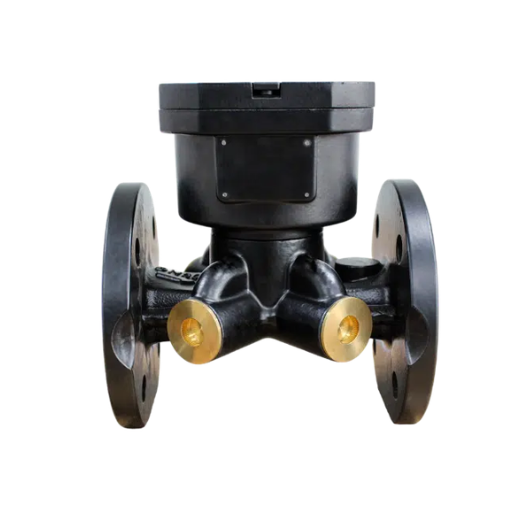
Every billing meter belongs to one of two families, and the split explains most of the trade-offs that follow. It is also the first thing to check when comparing water meter types.
Mechanical meters take energy from the water itself. A piston, disc, or rotor turns as water passes, and a register counts the rotations. They need no power, cost less, and are familiar to every installation crew. They also wear, and their accuracy drifts as bearings and chambers age.
Static meters have no moving measuring element. Electromagnetic and ultrasonic designs measure a property of the flowing water, then compute volume electronically. They hold accuracy better over time and see far lower flows, but they need power, cost more, and are more sensitive to installation quality.
Neither family wins outright. A utility that replaces every mechanical meter with a static meter will improve low-flow capture and lose the ability to install in a pit with no power and no straight pipe. A utility that stays mechanical will keep paying for water it never bills.
The rest of this guide works through each family, then shows how to match one to a real flow profile.
Mechanical Types of Water Meters
Mechanical meters dominate residential billing worldwide because they are inexpensive, self-powered, and repairable. Four designs matter commercially, and Black Ant’s mechanical water meters cover the residential end of that family.
Positive Displacement Meters: The Low-Flow Standard
A positive displacement (PD) meter traps a fixed volume of water and counts how many times that volume fills. Two designs dominate: the oscillating piston, common in Europe and Asia, and the nutating disc, common in North America. Both do the same job in different geometry.
Because every cycle passes a known volume, PD meters are exceptionally good at low flow. Modern units typically reach R160 to R250, and the best residential designs go higher. That matters at night, when a single dripping service line may be the only flow in the building.
The trade-off is dirt. Sand, grit, and suspended solids wear the chamber and can jam the piston. Air entrainment is worse: a PD meter can over-register when air passes through it, which is why air release and correct installation matter more here than on any other family. Typical sizes run from DN15 to DN50, with larger models available for light commercial use.
Choose PD when the water is clean, the flows are low and intermittent, and low-flow revenue capture is the priority. Black Ant’s small-diameter water meters cover this residential and light-commercial segment in mechanical and smart variants.
Single-Jet and Multi-Jet Meters
Jet meters are velocity meters. Water enters through one or more jets and drives an impeller; the impeller speed is proportional to flow.
A single-jet meter uses one tangential jet. It is simple and cheap, but the rotor is loaded unevenly, so bearing wear and low-flow accuracy are weaker. A multi-jet meter splits the flow across several jets around the rotor, balancing the load. That improves starting flow, reduces wear, and is why multi-jet designs became the European residential default.
Typical performance runs from R80 to R160 for single-jet and R100 to R250 for multi-jet, depending on size and quality. Sizes range from DN15 to DN150. Neither design tolerates grit as well as a static meter, and both need a clean strainer upstream in dirty supplies.
The selection rule is simple. Use single-jet where cost is the dominant constraint and water quality is good. Use multi-jet where residential low-flow accuracy and service life justify a modest price premium.
Turbine and Woltmann Meters
Turbine meters place an axial rotor in the flow path. Water turns the rotor at a speed proportional to velocity, and the register converts revolutions to volume. The European name for the axial turbine design is Woltmann, and you will see both terms on datasheets.
These meters are built for high, steady flows. Sizes run from DN50 to DN500 and beyond. Accuracy is good in the upper range but falls away sharply at low flow, with typical R values between R50 and R200. A turbine meter on a building with large night-to-peak swings will miss the night flow entirely.
Turbine meters need a strainer and a developed flow profile. Typical guidance is 5 to 10 diameters of straight pipe upstream and 2 to 5 downstream, and the manufacturer’s requirement is the one that counts. They are the classic choice for district mains, plant intake, bulk transfer, and master metering where flows are high and continuous.
Black Ant’s large-diameter water meters cover this municipal and main-line segment with electromagnetic and ultrasonic measurement options as well as mechanical designs.
Compound Meters
A compound meter combines two measuring elements in one body: a small PD or jet meter for low flow and a large turbine for high flow, with a changeover valve that routes water to the appropriate element.
This solves the range problem. A hotel, hospital, school, or mixed-use building may draw a few hundred litres per hour overnight and tens of cubic metres at peak. A single turbine misses the low end; a single PD meter is impractical at the high end. A compound meter covers both.
The engineering work sits in the changeover point. Set it too high and the low-flow element is bypassed during normal daytime demand. Set it too low and the turbine never engages. Compound meters also carry more maintenance: two measuring elements, one valve, and a crossover that must be verified.
Static Types of Water Meters
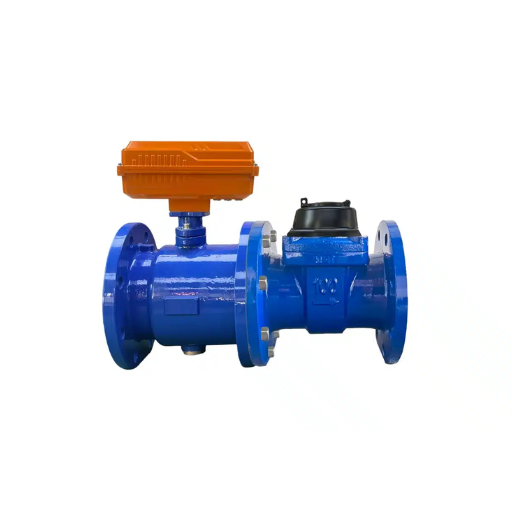
Static meters removed the moving part and, with it, most of the wear. Three designs are commercially relevant, plus two adjacent categories that are often confused with billing meters.
Electromagnetic Meters
An electromagnetic (mag) meter applies Faraday’s law: a conductive fluid moving through a magnetic field generates a voltage proportional to velocity. Electrodes in the pipe wall measure that voltage, and the meter integrates it into volume.
There’s nothing in the flow path. Head loss is essentially the same as a plain pipe section, accuracy holds across a wide range, and the meter handles dirty water, wastewater, sludge, and abrasive media that would destroy a mechanical element. Typical turndown is 100:1 to 250:1, with class 1 or class 2 billing accuracy available depending on the model.
The constraints are physical. The water must be conductive, typically at least a few tens of microsiemens per centimetre, so pure water and low-mineral water are poor candidates. The pipe must run full.
The liner and electrode material must also suit the water chemistry. And the meter needs power, whether mains or a battery pack.
Mag meters earn their cost in district mains, wastewater, industrial intake, and any application where the water is dirty and the flow is wide-ranging. For the principle applied in a flow-meter body, see our guide to electromagnetic flow meters.
Ultrasonic Meters
An ultrasonic meter measures the difference in transit time between a signal sent upstream and one sent downstream. The difference is proportional to flow velocity, and the meter converts it to volume.
Like mag meters, ultrasonic designs put nothing in the flow path. They typically reach R250 to R500, with high-end models going further, and they hold that range on battery power for a decade or more. That combination is why ultrasonic became the default measurement principle for smart water metering: a single battery-powered device can capture leakage-level flows, log interval data, and report over a radio network.
The weakness is entrained air. Bubbles scatter the signal and can cause missed or unstable readings, so installation must avoid pump suction, air pockets, and badly vented high points. Transducer fouling in iron-rich or scaling water also degrades performance, which is why some utilities specify a strainer or periodic cleaning.
Black Ant’s ultrasonic water meter range runs from DN15 to DN300, with starting flow from 1 L/h and battery configurations rated for 10 to 20 years, depending on reporting interval and network conditions.
Vortex Meters and Where They Fit
A vortex meter places a bluff body in the flow and counts the vortices shed behind it. Shedding frequency is proportional to velocity, so the meter infers flow from frequency.
Vortex meters are robust and have no moving parts, but they need a minimum Reynolds number to shed reliably. At low flow they simply stop measuring. That makes them a poor fit for domestic billing and a reasonable fit for industrial water lines, cooling water, and processes with steady, high flows. In water utility billing they are a niche choice.
Clamp-On and Insertion Meters
Clamp-on ultrasonic and insertion meters measure flow without breaking the pipe, or with a small probe insertion. They are valuable for verification, temporary measurement, leak surveys, and retrofits where shutting down a main is impossible.
They’re usually not custody-transfer devices. Accuracy depends on pipe wall thickness, lining, and a correctly entered pipe diameter, and the flow profile may be poor. Treat them as diagnostic tools unless the manufacturer explicitly certifies the installation for billing.
All Eight Types of Water Meters Compared: Specification Table
The table below is the shortcut version: the main types of water meters compared by working principle, size range, R value, accuracy, head loss, and installation demand. Values are typical ranges for commercially available billing meters; the datasheet for a specific model always overrides them.
| Family | Working principle | Typical DN | Typical R (Q3/Q1) | Accuracy | Head loss | Straight pipe | Dirty water | Best application |
|---|---|---|---|---|---|---|---|---|
| Positive displacement | Fixed chamber counts discrete volumes | DN15–DN50 | R160–R250 | Class 2 typical, class 1 available | Highest of the mechanical family | Minimal | Poor | Residential, low-flow revenue capture |
| Single-jet | One jet drives an impeller | DN15–DN40 | R80–R160 | Class 2 | Moderate | Minimal | Poor | Cost-sensitive domestic, clean water |
| Multi-jet | Multiple jets drive a balanced impeller | DN15–DN150 | R100–R250 | Class 2, class 1 available | Moderate | Minimal | Moderate | Residential and light commercial billing |
| Turbine / Woltmann | Axial rotor turned by flow | DN50–DN500+ | R50–R200 | Class 2 | Low at high flow | 5–10 D upstream, 2–5 D downstream | Moderate with strainer | District mains, bulk transfer, plant intake |
| Compound | PD element plus turbine with changeover valve | DN50–DN300 | Wide combined range | Class 2 | Low at high flow | Similar to turbine | Moderate | Hotels, hospitals, schools, mixed-use buildings |
| Electromagnetic | Faraday induction in conductive fluid | DN25–DN2000+ | R100–R250 | Class 1 or 2 | Negligible | 5 D upstream, 3 D downstream | Excellent | Wastewater, dirty water, district mains |
| Ultrasonic | Transit-time difference | DN15–DN3000 | R250–R500+ | Class 1 or 2 | Negligible | 10 D upstream, 5 D downstream | Good, but air-sensitive | Smart billing, DMA metering, leak detection |
| Vortex | Vortex shedding frequency | DN15–DN300 | Moderate | Class 2 in range | Low | 10–20 D upstream | Good | Industrial water, steady high flows |
Two columns deserve emphasis. Head loss is a permanent energy cost: a meter with a significant pressure drop adds pumping energy for the life of the installation. Straight pipe is a permanent installation constraint: if the mechanical room has no room for 10 diameters upstream, an ultrasonic meter may never perform to its datasheet.
Water Meter Selection Guide: How to Choose the Right Type
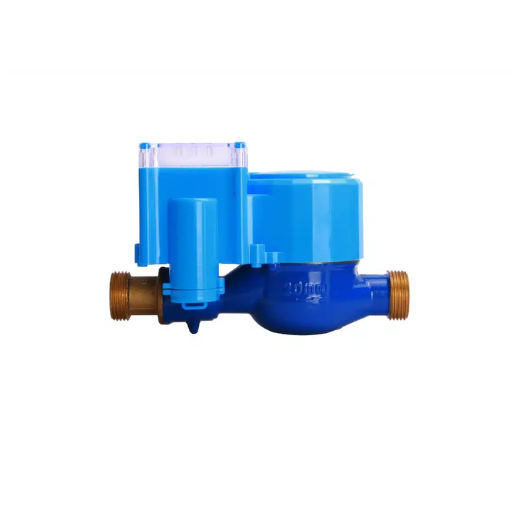
Selection is not a matter of picking the most advanced technology. It is a matter of matching the measurement principle to the flow profile, the water, and the installation. Five steps cover it.
Step 1: Establish the real flow profile
Collect minimum night flow, normal daytime flow, and peak demand. A meter is only as good as the range it actually sees. If night flow is 20 L/h and peak is 12 m³/h, the meter must cover a 600:1 range before any safety margin is added.
Step 2: Size on flow, not on pipe diameter
This is where most projects lose money. Sizing by pipe diameter produces an oversized meter, and an oversized meter under-registers at low flow. The utility then pays for water it supplies but cannot bill.
Oversizing and undersizing fail in opposite directions:
- Oversized: the meter runs below Q1 for much of the day, so low flows go unrecorded. Revenue falls, and the apparent leak rate looks better than it is.
- Undersized: head loss rises, noise appears at high flow, and the measuring element wears faster from continuous overload.
Size Q3 close to the highest sustained flow you expect, then check that Q1 sits below the lowest flow you need to bill. That check is the whole job.
Step 3: Characterise the water
Four questions decide more than any brochure:
- Solids: sand, grit, or sediment rules out PD and shortens jet-meter life.
- Air: entrained air distorts ultrasonic readings and can over-register PD meters.
- Conductivity: mag meters need conductive water; low-mineral water may not qualify.
- Temperature and chemistry: hot water, chlorination, and scaling all affect materials and drift.
Step 4: Check the installation constraints
Confirm available straight pipe, whether the pipe can run full, whether power is available, whether the pit floods, and whether the meter can be removed for verification without shutting the building. A technically superior meter that cannot be installed correctly will underperform a simpler meter that can.
Step 5: Define the commercial and data requirements
Decide the accuracy class, the verification interval, the required battery life, and how the reading will be collected. If the meter must feed a billing system or a DMA dashboard, the communication method becomes part of the meter selection, not an afterthought. We cover that separately in our NB-IoT vs LoRaWAN water meter guide, because the radio decision is independent of the measuring principle.
Matching Meter Type to Application
The matrix below matches the main water meter types to the applications where each one earns its cost.
| Application | Recommended families | Why |
|---|---|---|
| Single-family home | PD, single-jet, multi-jet | Low cost, no power, adequate low-flow accuracy |
| Apartment block, unit submetering | Multi-jet, PD, ultrasonic | Unit-level billing; ultrasonic where leak alerts and remote reading matter |
| Office or retail building | Multi-jet, compound, ultrasonic | Mixed demand profile; compound where peaks are wide |
| Hotel, hospital, school | Compound, electromagnetic | Large night-to-peak swing with high peak demand |
| District main or bulk transfer | Turbine, electromagnetic, ultrasonic | High flows; low head loss and wide range matter |
| Wastewater and industrial intake | Electromagnetic | Dirty, abrasive, conductive media |
| Irrigation and agriculture | Turbine, electromagnetic | High seasonal flows; debris tolerance |
| Network DMA and leak detection | Ultrasonic, electromagnetic | Low-flow sensitivity and interval data |
A worked example
Consider a 220-unit residential development with a single bulk meter and unit-level submeters. Peak demand at the bulk point is about 14 m³/h; night flow is around 0.4 m³/h, falling to 0.15 m³/h once the last irrigation timer shuts off.
A DN50 turbine sized on the pipe would cover the peak comfortably and miss the night flow almost entirely. A DN50 compound covers both but adds a changeover valve and maintenance. An electromagnetic or ultrasonic DN50 covers the full range with negligible head loss, at a higher unit price.
For the unit meters, the decision is different: DN15 or DN20 multi-jet or ultrasonic, depending on whether the owner wants remote reading and leak alerts. The bulk meter protects revenue at the boundary; the unit meters allocate cost. They do not need the same technology, and choosing them separately usually saves money. For buildings that bill tenants directly, our guide to building submetering with IoT water meters covers the metering plan.
Smart, Prepaid, and Hot-Water Variants
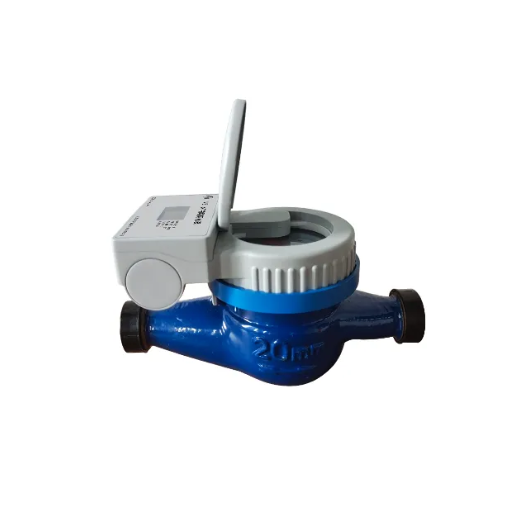
The measuring principle is only one layer of meter typing. Buyers also select by reading method, payment model, and temperature duty.
Smart and IoT Meters
A smart meter adds communication and data handling to a measuring element. There are three routes:
- Native static smart meter: an ultrasonic or mag meter with an integrated radio and data logger.
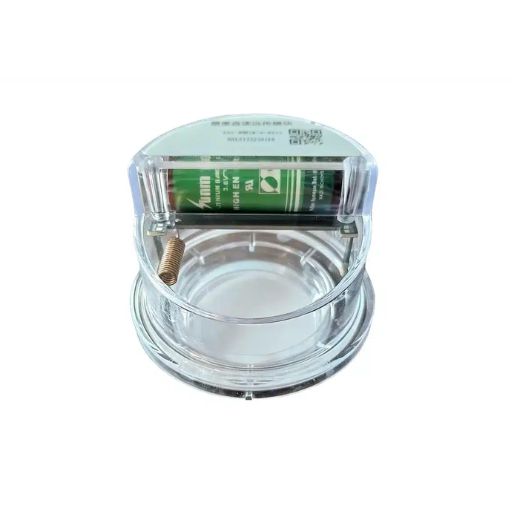
- Mechanical meter with an add-on module: a pulse or M-Bus module attached to an existing mechanical meter.
- Camera direct-reading retrofit: an optical unit reads the existing dial and transmits the value, with no plumbing change.
The first route gives the best data and the longest battery life. The third route is the cheapest way to automate a large mechanical fleet without replacing calibrated meters. Black Ant’s camera direct-reading water meter exists specifically for that retrofit case.
Reading systems split into AMR (automated meter reading, often walk-by or drive-by) and AMI (advanced metering infrastructure, a fixed two-way network with interval data). The distinction matters for what the utility can do with the data, not for the meter’s accuracy.
Prepaid Meters
Prepaid meters require payment before supply. The common designs use an IC card, a token or keypad code, or an RFID tag. They are standard in rental housing, utility service areas with high collection risk, and parts of Africa and Asia where prepayment reduces arrears. Black Ant’s IC card prepaid water meters cover the card-based residential variant.
The trade-off is service. A prepaid meter shifts credit risk to the customer and can leave a household without water when credit runs out. Many utilities now prefer postpaid smart metering with remote disconnection, which delivers the same revenue protection without the social cost.
Hot-Water and Heat Meters
A hot-water meter measures volume at elevated temperature. A heat meter goes further: it combines a flow meter, two temperature sensors, and a calculator to compute thermal energy in kWh. The relevant standard is EN 1434, and the EU instrument directive covers heat meters under MI-004.
Materials, seals, and registers must suit the temperature class, typically T30, T50, T90, or T130. A cold-water meter installed on a hot-water line will fail early and may read incorrectly. District heating and building submetering usually specify a heat meter rather than a water meter, because the bill is for energy, not volume. Black Ant’s ultrasonic heat meters cover district heating and building submetering applications with M-Bus and RS485 output.
What the Standards Actually Require
Datasheets are full of letters and numbers that look interchangeable and are not. Four concepts cover most of what a buyer needs.
Q3, Q1, and the R Value
ISO 4064 and OIML R49 define four flow rates:
- Q1: the lowest flow at which the meter must meet its accuracy limit.
- Q2: the transitional flow between the lower and upper accuracy zones.
- Q3: the permanent flow, used for normal sizing.
- Q4: the overload flow, used briefly without damage.
The R value is simply Q3 divided by Q1, which flow meters express as turndown ratio. An R160 meter with a Q3 of 4 m³/h has a Q1 of 25 L/h. An R250 meter of the same Q3 would start measuring at 16 L/h. That’s the entire meaning of the number, and it’s the most useful single figure on a residential meter datasheet.
Accuracy Classes 1 and 2
Current editions of ISO 4064 and OIML R49 use two accuracy classes:
| Class | Maximum permissible error, Q1 to Q2 | Maximum permissible error, Q2 to Q4 |
|---|---|---|
| Class 1 | ±5% | ±1% |
| Class 2 | ±5% | ±2% |
Class 2 is the normal billing grade. Class 1 is specified where higher accuracy justifies the cost, such as large bulk transfers or regulatory settlement.
You will still see references to the older Class A, B, and C system from the 1993 edition of ISO 4064. Those letters are not equivalent to classes 1 and 2, and a datasheet that mixes the two should be treated with suspicion. Ask which edition the certificate references.
The Standards You Will See on a Datasheet
- ISO 4064-1: the international product standard for water meters, covering terminology, requirements, test methods, and non-metrological requirements.
- OIML R49: the metrological recommendation that defines Q1 to Q4, accuracy classes, and test procedures. ISO 4064 and OIML R49 are aligned in their current editions.
- EU MID 2014/32/EU, Annex MI-001: the CE-marking route for water meters sold for utility billing in the EU. It applies the class 1 and class 2 accuracy limits.
- AWWA C700, C701, C702, C703, and C708: the North American standards for displacement, turbine, compound, fire-service, and multi-jet meters. They use imperial sizes and a different testing tradition, which is why US datasheets do not map cleanly onto metric R values.
- GB/T 778: the Chinese standard for water meters, aligned with ISO 4064 and used for domestic utility procurement.
- NSF/ANSI/CAN 61 and 372: US and Canadian requirements for materials in contact with drinking water, including lead content.
- WRAS: UK approval for water fittings.
For EU and UK projects, check that the certificate names the directive or scheme, the accuracy class, and the flow range. A CE mark on the enclosure is not the same as MID certification of the meter.
Installation and Maintenance Essentials
Most meter failures are installation failures. Six checks prevent the majority of them.
- Flush the line before installation. Construction debris destroys PD and jet meters, and it fouls electrodes and transducers.
- Fit a strainer where the family requires it. Turbine and compound meters need one; PD and jet meters benefit from one.
- Respect the straight-pipe requirement. It’s a performance condition, not a suggestion. If the layout can’t meet it, choose a different meter rather than hoping.
- Keep the pipe full. Mag and ultrasonic meters need full-bore flow. Air pockets at high points cause instability and lost readings.
- Protect against frost and flooding. A frozen chamber cracks; a flooded pit destroys electronics. Specify the IP rating against the actual pit condition, not the showroom.
- Plan verification. Mechanical meters drift; static meters drift more slowly but still need checking. Decide the interval and keep a bypass or a removable spool so verification does not require a shutdown.
Battery life deserves its own line, and our guide to smart water meter battery life covers the variables in full. A 10-year claim is conditional on reporting interval, network conditions, and temperature. Always ask for the assumption behind the number, then compare it with your read schedule.
Frequently Asked Questions
How many different types of water meters are there?
For practical purposes, two families and eight common designs: positive displacement, single-jet, multi-jet, turbine or Woltmann, compound, electromagnetic, ultrasonic, and vortex. Reading method and payment model add further variants on top of those.
Which type of water meter is most accurate?
Electromagnetic and ultrasonic meters hold the widest accurate range, typically class 1 or class 2 across R100 to R500. Positive displacement meters are excellent at very low flow for their price. The honest answer is that installation quality affects accuracy more than the family label.
What is the most common type of water meter?
Multi-jet and positive displacement meters dominate residential billing worldwide. Turbine and electromagnetic meters dominate bulk and municipal main-line metering, while ultrasonic is now the default for new smart metering projects.
What does R160 mean on a water meter?
R160 is the ratio of permanent flow Q3 to minimum flow Q1. A meter with Q3 of 4 m³/h and R160 must accurately measure down to 25 L/h. A higher R value means the meter can see lower flows, which usually means better leakage and night-flow capture.
Can a mechanical meter be made smart?
Yes. You can add a pulse or M-Bus module, or fit a camera direct-reading unit that reads the existing dial. Both avoid replacing a calibrated meter. A camera retrofit is usually the lowest-cost route for a large mechanical fleet.
Do I need a different meter for hot water?
Yes. Hot-water and heat metering requires temperature-rated materials and, for energy billing, a heat meter with temperature sensors and a calculator. A cold-water meter on a hot line will fail early and may read incorrectly.
Conclusion
The types of water meters available today cover a wider performance range than most specifications acknowledge. Positive displacement and jet meters remain the right answer for clean water and low cost. Turbine and compound meters handle high and highly variable flows.
Electromagnetic meters own dirty water. Ultrasonic meters own the smart-billing range where low-flow sensitivity, battery life, and interval data all matter at once.
The selection decision comes down to five inputs: the real flow profile, the water quality, the installation constraints, the accuracy class, and the data requirement. Get those right and the family choice becomes obvious. Get them wrong and no amount of specification detail will rescue the installation.
If you are specifying meters for a building, a district, or an OEM programme, our engineering team can review the flow profile and recommend a configuration across mechanical, electromagnetic, and ultrasonic options. Browse the full water meter range or talk to our metering engineers about your project.