
Radar Level Gauge: Non-Contact Measurement for Industrial TanksUnderstanding Radar Level Gauge Technology and Operating Principles
Accurate liquid level measurement is essential for efficiency, safety, and inventory management in industries like chemical processing, oil and gas, water treatment, food, and pharmaceuticals. Radar level gauges offer precise, non-contact monitoring using microwave signals, ensuring reliable performance even in harsh conditions.


Key Advantages of Radar Level Gauge for Industrial Applications
Radar level measurement systems offer non-contact sensing, which prevents corrosion, coating, and contamination, ensuring product purity.
Radar level sensors offer exceptional measurement accuracy of ±1mm with fast response times as quick as 100ms, ensuring precise inventory management and real-time process control across all industrial applications.
The non-contact operation and absence of moving parts dramatically reduce maintenance costs and downtime compared to mechanical systems, extending service life beyond 15 years in typical industrial environments.

Performance remains stable regardless of environmental factors including temperature variations from -40°C to 1000°C, pressure fluctuations, humidity up to 95%RH, and the presence of dust, vapor, or foam.
Suitable for measuring liquids and solids across diverse industries including oil and gas, chemical processing, water treatment, food and beverage, and pharmaceuticals, accommodating materials with dielectric constants ≥2.
Our Radar Level Gauge Models
We offer comprehensive radar level gauge solutions engineered for diverse industrial requirements, delivering reliable tank measurement performance across standard and high-precision applications.
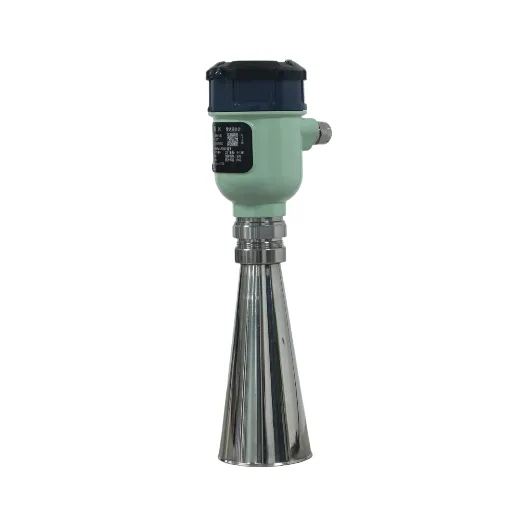
HOR Radar Level/Liquid Level Gauge
Key Features of Radar Level Gauge
Our radar level measurement systems incorporate advanced technology and robust engineering to deliver superior performance, ensuring accurate and dependable level monitoring across the most challenging industrial environments.
Detailed Technical Specifications
| Parameter | Specification |
|---|---|
| Transmit Frequency | 26GHz (Standard) / 80GHz (High Precision) |
| Measurement Range | Liquid: 0-30m (extendable to 70m) |
| Solid: 0-20m (extendable to 35m) | |
| Accuracy | ±1mm |
| Beam Angle | 3° / 18° / 20° |
| Power Supply | 24VDC / 220VAC |
| Signal Output | 4-20mA/HART / RS485/Modbus |
| Operating Temperature | -40°C to 1000°C |
| Housing Material | Aluminum alloy / Stainless steel |
| Process Connection | Thread / Flange / Sanitary clamp |
| Protection Rating | IP67 |
| Explosion Protection | Exdia II CT6 |
Application Areas for Radar Level Gauge
The versatility of radar level measurement systems makes them the solution of choice across diverse industries, each with unique challenges and requirements.
Oil and Gas Sector
Radar tank gauge systems are essential from production to refining, offering precise measurement, leak detection, and efficient tank management. On offshore platforms, these sensors remain accurate despite motion, temperature changes, and explosive risks. Tank farms use multiple radar transmitters with centralized control systems for complete inventory management.
Chemical Processing
Non-contact radar level sensors are ideal for aggressive chemicals and high temperatures. Measuring corrosive liquids without media contact prevents contamination, and the explosion-proof design meets hazardous area regulations. This precise level control optimizes batch processes, improving yield and product quality.
Water and Wastewater Management
Municipal water plants and industrial facilities use radar level measurement for clarifiers, tanks, and lift stations. It provides real-time data to optimize processes, prevent overflows, and ensure compliance. Reservoir and network monitoring aids in demand forecasting and system efficiency.
Food and Beverage Industry
Hygienic clamp-mounted radar sensors are essential for breweries, dairies, and food plants, ensuring non-contact liquid level measurement that prevents contamination and meets FDA/EHEDG standards. They also provide accurate silo level readings despite dust and material variations.
Positive Displacement Water Meters: How They Work
A worn positive displacement water meter doesn’t fail. It keeps turning, keeps billing, and quietly under-reports. A burst main gets…
Choosing a 4-20 mA Signal Isolator for Pressure Transmitters: Ground Loops and Active/Passive Inputs
Choose a 4-20 mA signal isolator by matching the power roles on both sides, the required isolation boundaries, and each…
NAMUR NE43 for Pressure Transmitters: Fault Current vs Measurement Saturation
NAMUR NE43 separates failure signals from pressure readings in an analog current loop. At saturation, the transmitter has reached its…
Maintenance, Calibration, and Long-Term Operational Considerations
Periodic visual inspection of the antenna surface ensures it remains clean and free from coating buildup. Most applications require inspection only during scheduled shutdowns. For particularly dirty applications, compressed air or steam cleaning maintains optimal performance.
Built-in diagnostic functions monitor signal strength, echo quality, and system health parameters. Advanced radar level sensors offer alert notifications when signal quality degrades, enabling proactive maintenance before measurement accuracy is compromised.
While the radar sensor maintains factory calibration throughout its service life, periodic verification against known reference levels confirms continued accuracy. The HART or Modbus interface simplifies remote calibration checks without vessel entry.
Ensuring the IP67-rated enclosure remains sealed protects internal electronics from moisture and dust ingress. Annual inspection of cable glands and housing seals prevents environmental damage.


Why Choose Our Radar Level Gauge?
Frequently Asked Questions (FAQs)
Find answers to common questions about radar level measurement technology, helping you make informed decisions for your industrial level measurement applications and understand the capabilities of our radar level sensors.
01
01
The primary difference lies in beam focus and application suitability. The 80 GHz radar technology offers a narrower 3° beam angle compared to 26GHz models with 18-20° beams, providing superior performance in small vessels, applications with internal obstructions, and situations requiring maximum measurement range. The 26GHz standard frequency suits most general-purpose tank gauge applications and offers excellent value for larger vessels.
02
02
Yes, our radar level measurement systems effectively measure both liquid and solid materials. Liquid measurement range extends from 0-30m (expandable to 70m), while solid materials can be measured from 0-20m (expandable to 35m). The key requirement is that the measured material must have a dielectric constant ≥2 to provide adequate signal reflection for accurate measurement.
03
03
Radar level sensors offer significant advantages over ultrasonic level sensors. Radar technology is unaffected by temperature gradients, pressure variations, vapor, dust, or foam that can compromise ultrasonic performance. Radar sensors maintain high accuracy across extreme temperatures from -40°C to 1000°C, while ultrasonic sensors typically limit to -20°C to 60°C. Additionally, radar provides superior accuracy and longer measurement ranges.
04
04
Minimal maintenance is required due to the non-contact design and absence of moving parts. Recommended maintenance includes periodic visual inspection of the antenna during scheduled shutdowns, monitoring built-in diagnostics for signal quality, and annual verification of enclosure seals. Most installations require maintenance only every 2-3 years, significantly less than mechanical level gauge systems or guided wave radar requiring probe inspection.
05
05
Yes, our radar level sensors are certified for hazardous area installation with Exdia II CT6 explosion-proof rating, meeting international standards for use in environments with flammable gases, vapors, or combustible dust. For critical safety applications, we offer SIL 2 and SIL 3 rated versions complying with functional safety requirements in oil and gas, chemical processing, and other high-risk industries.
06
06
Our radar level transmitters support multiple communication protocols for seamless integration with existing control systems. Two-wire configurations offer 4-20mA analog output with HART digital protocol overlay for configuration and diagnostics. Four-wire models provide RS485/Modbus connectivity for direct PLC and SCADA integration. Wireless communication options enable remote monitoring and control in locations where cabling is impractical.
07
07
Process connection selection depends on your vessel configuration, industry standards, and application requirements. Threaded connections (NPT/BSP) suit smaller vessels and retrofit applications. Flanged connections accommodate ANSI, DIN, and JIS standards for larger installations. Sanitary clamp connections meet hygienic requirements for food, beverage, and pharmaceutical applications. Consult our technical team for guidance on optimal antenna and connection selection for your specific application.
